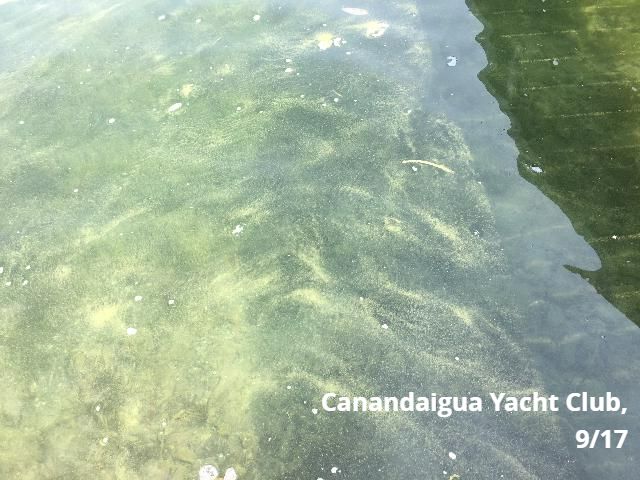
Water Quality Update for September 16, 2022

Current Lake Conditions:

Harmful Algae Blooms: No Blooms Reported

Average Secchi Disk Water Clarity: 4.93 meters

Average Surface Water Temperature: 72.6 F

Lake Level: 687.88 feet above sea level (desired level 688.25) Main gates have been closed all summer and feeder canal is at minimum required flow.

This week was a quiet one for HABs, with no blooms reported. Shoreline HAB monitors have been reporting clear conditions this week with no visual evidence of cyanobacteria streaks or surface accumalations. Water temperatures are cooling down, and we are beginning to feel the shift into the fall season.

This is a change from last week’s update and last week’s HABs reporting, which recorded 8 confirmed blooms in the lake.

We have received several lake foam reports this week – areas where foam was being pushed by wave and wind action along shorelines. There were also reports of foam streaks going along the length of the lake. The timing of the foam seems consistent with previous years – although foam can also be found throughout the seasons in Canandaigua Lake. Since foam is sticky in nature, it can concentrate cyanobacteria and other substances at higher levels than in the surrounding environment, so exercise caution when coming into contact with foam.

For more information on past foam research, check out the CLWA website: https://www.canandaigualakeassoc.org/water-quality/lake-foam/. Residents are also welcomed to submit foam reports using a simple survey embedded on the bottom of the webpage. Researchers are monitoring the reports coming in.

Please continue to use your visual indicators when recreating in the lake – conditions may change daily, if not hourly, so look for signs of surface streaking of algae, surface scums, or green/discolored water. These areas should be avoided.

Have a great weekend everyone!

Posted in Water Quality Updates

Water Quality Update for September 9, 2022

WATER QUALITY UPDATE

September 9, 2022

Current Lake Conditions:

Harmful Algae Blooms: 6 Blooms Reported today 9/9

Average Secchi Disk Water Clarity: 4.65 meters

Average Surface Water Temperature: 72.9 F

Lake Level: 687.85 feet above sea level (desired level 688.35) Main gates have been closed all summer and feeder canal is at minimum required flow.

After a relatively calm week, bloom activity has picked up, with 6 bloom reports submitted today. So far, the reports have come mainly from the east side of the lake – from the Rushville area up as far north as Kershaw Park. See images below.
Image of surface streaking captured today (9/9) in Cottage City around 1:30 pm.
Image of bloom along shoreline along with heavy “dots” in the water this afternoon.
Today’s calm weather means we may get more reports from other areas of the lake as the day progresses. Please keep an eye out for signs of surface streaking of algae, heavy “dots in the water”, surface scums, or green/discolored water. These areas should be avoided.

Based on past sampling efforts in Canandaigua Lake, we know that the cyanobacteria blooms can produce high toxins, so it is best to avoid contact with all blooms.  Please also use caution before letting dogs in the water. Pets (especially dogs) are very susceptible to the toxins associated with blooms as they are likely to drink surface waters when swimming and may also be exposed when grooming themselves after a swim in the lake. For more information on Dogs and HABs, please check out this informational brochure.

If you have questions please dont hesitate to reach out to our HABs email address at HABs@canandaigualakeassoc.org, which is received by both the Canandaigua Lake Watershed Council and CLWA.

Posted in Water Quality Updates

Water Quality Update for September 2, 2022

WATER QUALITY UPDATE

September 2, 2022

Current Lake Conditions:

Harmful Algae Blooms: No Blooms Reported

Average Secchi Disk Water Clarity: 4.3 meters

Average Surface Water Temperature: 74.2 F

Lake Level: 687.9 feet above sea level (desired level 688.35) Main gates have been closed all summer and feeder canal is at minimum required flow.


The Labor Day holiday weekend is upon us, and we are all looking forward to a long weekend spent with family, friends, and some great times by the lake. With this comes the question – how will the water look this weekend?

Unfortunately, there is no water quality “crystal ball” to look into to predict the future (wouldn’t that be great?), but we do have the benefit of a strong monitoring network paired with scientific data to help us assess lake conditions.

Here’s what we know:

  • The good news: there were no blooms reported this week (survey week running August 26- September 1).
  • The not so good news: the average secchi disk water clarity readings have been dropping – from 5.4 meters last week, to 4.3 meters this week. This may indicate an increase in algal production in the water column.

We’ve also had a stretch of breezy, windy days which keeps surface waters fairly well mixed. We most often see blooms on calm, windless days – so conditions have not been ideal for cyanobacteria to form surface blooms.

As we head into the weekend, we hope this trend of “no blooms” continues. However, on Canandaigua Lake, the Labor Day holiday weekend and the week following has historically given us some of our first major bloom activity of the season. Again, no crystal ball here – but the potential for isolated blooms to pop up is increasing. Please continue to use your visual indicators when recreating in the lake – look for signs of surface streaking of algae, surface scums, or green/discolored water. These areas should be avoided.

Have a great weekend everyone. Enjoy the Ring of Fire with your environmentally-friendly LED flares this year! If you’re still looking for something to do this weekend, check out the festivities at the Seneca Heritage Day on Saturday, September 3rd from 2-4 pm.

Posted in Water Quality Updates

Experience of a Macrophyte Survey Volunteer: Ellie Huang

It’s a cool day and you are wading through the tranquil waters of Canandaigua Lake. Suddenly, a sharp pain shoots through your foot. You have just stepped on one of the troublesome invasive species in the Finger Lakes region—a water chestnut. 

Our freshwater resources are increasingly more valuable and vulnerable. One of the major threats to most bodies of water are invasive species. These species disturb ecosystems by spreading disease, displacing native species, and destroying habitats. The water chestnut, for example is an invasive species that spreads by clinging onto boats, fishing equipment, etc. and reproduces rapidly. This causes dense growths of water chestnut that can impede ships and swimmers and displace native vegetation. When the water chestnuts die, the decomposing leaves use up the dissolved oxygen in the water which can lead to fish kills. Hydrilla is another invasive species prevalent in the finger lakes area. Similar to water chestnuts, hydrilla grow very quickly which cause problems like lowering dissolved oxygen, destroying food and habitat for native species, and interfering with recreational water use. Luckily, programs like the Finger Lakes Institute Macrophyte Survey Program (MSP) are great ways to help your local watershed battle with these pesky invasive species. 

As an MSP volunteer, I monitor a local waterbody for invasive species and keep track of what kinds of native species are present. I typically do rake tosses about once a week, but you can adjust the frequency and timing to work with your schedule! Here is a look at a typical MSP rake toss.

First, I drive down to my nearest waterbody (this can be any lake/inlet within the Finger Lakes watershed!) and find a dock to set up. I always bring my MSP kit (includes a rake, identification booklet, sampling container, ruler for scale) and sometimes a bottle of water if it’s hot.

Next, I throw the rake into the water. Sometimes throwing the rake farther out is more effective while other times just dropping the rake is enough. I wait for about a minute to give the rake time to settle to the bottom where most plants are.

Next step is my favorite! I pull the rake out of the water and get to see all the plants I have collected. Somedays there will be many clusters of bushy coontail, while other days there might only be a tiny strand of water stargrass. 

Next is identification. I separate the plants based on species. Usually, plants of the same species will be tangled together in a bunch. I look for things like leaf shape and pattern, color, and number of leaves to distinguish different species. Once I have my piles, I start identifying each pile using the same qualities. I use the booklet or google if I am struggling. Remember, guessing is totally fine!


Some of my most common finds are coontail, water stargrass, and Eurasian water milfoil. Coontail is identifiable by its structure. While most plant leaves will flop over when pulled from the water, coontail maintains its structure. Another characteristic are its unique forked leaves. Fortunately, coontail is a harmless native species! Water stargrass is another native species. It is a very ordinary looking plant that resembles grass. I identify it by its thin, alternating leaves. I recently identified my first invasive species which was Eurasian water milfoil. I identified this plant by its floppy structure, thin leaves, and bushy leaflets.

(If you are doing another rake toss, now is a good time to throw the rake into the water so it can sink while you work)

After identifying the plants, it is time to upload the data. Using the app Surve123 I fill out the MSP data form. The form asks for location, water depth, species identified, and photos, along with a few other basic questions. When taking photos, I try to photograph identifying characteristics of the plants. Afterwards I just hit send!

Protecting the health of our waterbodies is simple, fun, and essential! There are many ways to get involved in watershed protection by joining one of the volunteer programs offered by the Canandaigua Lake Watershed Association, Finger Lakes Institute, or other local environmental groups. Contact the CLWA office to learn more (585) 394-5030. 

About the writer:

Hi! I’m Ellie Huang and I am a rising senior at Pittsford Sutherland High School. I’m passionate about sustainability and protecting our natural resources—especially water. Next year, I’m hoping to major in environmental studies! If I’m not out enjoying nature, you can typically find me talking with friends at a coffee shop, practicing violin, playing volleyball, or working out at the gym.

Posted in Uncategorized

Water Quality Update for August 26, 2022

WATER QUALITY UPDATE

August 26, 2022

Current Lake Conditions:

Harmful Algae Blooms: 3 Confirmed Blooms

Average Secchi Disk Water Clarity: 5.8 meters

Average Surface Water Temperature: 75.3 F

Lake Level: 687.97 feet above sea level (desired level 688.41) Main gates have been closed all summer and feeder canal is at minimum required flow.

Good Afternoon,

Shoreline harmful algae bloom volunteers completed their 5th week of monitoring, this week reporting three confirmed blooms and one suspicious bloom.

The three confirmed blooms were reported last Friday afternoon (August 19th), and were all from the east side of the lake. Volunteers reported surface streaking and heavy “dots in the water” (microcystis colonies). One report was from an offshore area (from a boat) and the other two were shoreline reports. See images below.

Surface streaking reported on 8/19 in the Crystal Beach area (sample collected)
Image of heavy “dots in the water” and surface streaking offshore on 8/19
A sample was collected from one of the shoreline blooms in the Crystal beach area. As part of this program, we like to collect samples from the “early” blooms to get a baseline of what we are seeing in terms of cyanobacteria levels this time of year, recognizing that conditions may vary from site to site.  Levels came back at 36.68 ug/L (micrograms per liter) of cyanobacteria. The NYS DEC deems a bloom above 25 ug/L of cyanobacteria, which confirmed this bloom status.

We have been anticipating isolated bloom reports based on the time of year, as well the bloom activity reported around the Finger Lakes. Overall, we are not seeing substantial concerns with cyanobacteria levels, but isolated blooms may occur and can pop up quickly in the right conditions.  As part of an end-of-dock monitoring program in partnership with SUNY ESF (Environmental Science and Forestry), 6 sites are tested weekly to monitor ambient cyanobacteria levels in the lake, and these levels remain very low. Water clarity as reported by our secchi disk volunteers remains good and the limited HABs reports thus far have been more surface streaking levels and not pea soup conditions.

Please continue to use your visual indicators when recreating in the lake – conditions may change daily, if not hourly, so look for signs of surface streaking of algae, surface scums, or green/discolored water. These areas should be avoided.

Have a nice weekend everyone! If you are looking for something to do, consider watching the recording of the CLWA 2022 Annual Meeting, or stocking up on LED Flares for the upcoming Ring of Fire Celebration. $1 per LED Flare sold at Wegmans in Canandaigua will be donated to CLWA!

Posted in Water Quality Updates

Water Quaity Update for August 20, 2022

WATER QUALITY UPDATE

August 20, 2022

Current Lake Conditions:

Harmful Algae Blooms: No Blooms Reported

Average Secchi Disk Water Clarity: 6.0 meters

Average Surface Water Temperature: 76.0 F

Lake Level: 687.89  feet above sea level (desired level 688.46)  Main gates have been closed all summer and feeder canal is at minimum required flow.

Good afternoon everyone,

Canandaigua Lake made it on the map this week, with the first bloom of the season reported on the morning of Tuesday, August 16th. The initial report came in by a member of the community through the HABs@canandaigualakeassoc.org email address, accompanied by a photo. In response to this report, a CLWA trained volunteer surveyed the area and took a sample. The sampled bloom location was off the west side of the City Pier near Sutters Marina, and was large but localized. This area has little water movement and a lot of plant fragments, and streaks of cyanobacteria were observed mixed in with some of the plant fragments in this area (see image, below).

Trained volunteers and watershed staff submitted 57 reports from around the lake this week, and the 8/16 bloom has so far been the only bloom reported.

Weekly average secchi disk readings have been holding consistently in the 6-meter range for the last 3 weeks, meaning that water clarity has not been reducing drastically. These volunteer secchi readings are helping us understand the amount of cyanobacteria in the water column. The consistency in readings means there has been no big increase in the algal biomass.

Based on bloom activity across the Finger Lakes region this past week, we know that the potential for isolated blooms to pop up is increasing. Please continue to use your visual indicators when recreating in the lake – conditions may change daily, if not hourly, so look for signs of surface streaking of algae, surface scums, or green/discolored water. See images at the bottom of this email for examples. These areas should be avoided.

Have a nice weekend everyone!

Posted in Water Quality Updates

Water Quality Update for August 12, 2022

Current Lake Conditions:

Harmful Algae Blooms: No Blooms Reported

Average Secchi Disk Water Clarity: 6.28 meters

Average Surface Water Temperature: 76.3 F

Lake Level: 687.92 feet above sea level (desired level 688.5) – Drought conditions have substantially reduced inflow to the lake, direct precipitation on the lake and enhanced evaporation of the lake surface. Main gates have been closed all summer and feeder canal is at minimum required flow.


Happy Friday Everyone! This week’s water quality update brings another week with no harmful algal blooms reported on Canandaigua Lake

Activity has picked up among several of our neighboring Finger Lakes, with isolated blooms reported on Owasco, Skaneateles, Cayuga, Keuka, Honeoye, and Canadice Lakes over the past 7 days. (See the NYS Department of Environmental Conservation NYHABS page for an interactive map.) This knowledge, paired with warming water temperatures means that blooms may be around the corner for us too. We know from past experience that conditions can change rapidly, so please be sure to use your visual indicators to look for signs of surface streaking of cyanobacteria. Check out images on our HABs page to know what to look for. 


Secchi disk volunteers are reporting good clarity in recent days, ranging from 5.4 to 6.9 meters – an increase from last week. Looking at the yearly trends in water clarity readings, we have historically seen a peak in clarity mid-August, before an end-of- August downturn and subsequent HAB event. Great clarity means more sunlight penetration in the water column, and when cyanobacteria levels begin to increase in our lake (as typical this time of year), sunlight can cause the cyanobacteria to proliferate when the conditions are just right.

Keep us posted if you see anything, and rest assured there are many eyes out on the lake between watershed staff, the 62 active shoreline monitoring zones, and 18 mid-lake secchi disk locations that are surveyed very frequently. Questions can be emailed to HABs@canandaigualakeassoc.org. We thank all of our awesome volunteers for their assistance!

If you haven’t done so yet, please register for the CLWA Annual Meeting this upcoming Tuesday, August 16th at 7:00 PM via zoom to learn more about water quality. DEC Research Scientist Tony Prestigiacomo will present Harmful Algal Blooms in Deep Places: A Finger Lakes Case Study, and we will also have an update on watershed projects from Kevin Olvany of the Canandaigua Lake Watershed Council.

No bloom images to report, but please enjoy this photo of a school of minnows swimming along the east side of the lake on Wednesday afternoon.

Posted in Water Quality Updates

Water Quality Update for August 5, 2022

WATER QUALITY UPDATE
August 5, 2022
Current Lake Conditions:
Harmful Algae Blooms: No Blooms Reported
Average Secchi Disk Water Clarity: 5.82 meters
Average Surface Water Temperature: 77.4 F
Good afternoon everyone! We will keep this week’s update short and sweet  – no blooms have been reported this week.
The average surface temperature has increased by 1.1 degrees fahrenheit from last week’s recorded average temperature of 76.3 degrees F.  As surface water temps increase and we shift into that mid-August timeframe, our volunteers and watershed staff are keeping an active eye on water quality, with 148 shoreline surveys completed already this summer!  From previous year’s data, we know that mid-August has been a time where we’ve historically started to see isolated pockets of cyanobacteria along shoreline areas. Secchi disk water clarity readings did increase from last week, but the weekly average is trending slightly below this time last year. All this information gathered by our community scientists is taken into account when looking at the current status of the lake, and where we might head in the near future. We thank each of our incredible volunteers for their commitment to consistent and accurate reporting.
Until then –  jump on it, and enjoy the hot weekend ahead! And please consider joining us at the CLWA Annual Meeting on Tuesday, August 16th at 7 PM via zoom as we hear from our Department of Environmental Conservation Watershed Hub Representative Tony Presigiacomo. Tony will share insights from his HABs intensive research study on Canandaigua Lake. Information on how to register can be found below!
Today, we saw some much-needed rain across portions of the watershed. The DEC recently put out information about current drought conditions, and although Ontario and Yates County have not hit drought status, we are in a “drought watch”. There are no statewide mandatory water use restrictions in place under a drought watch, but residents are strongly encouraged to voluntarily conserve water.
Check out this incredible image of this afternoon’s rains rolling across the watershed, captured at 1:45 pm today from the scenic overlook at County Road 12 in South Bristol. Thanks to Grant Taylor Photography for sharing this image with us.
Image by Grant Taylor Photography, 8/5/2022
Join us on Tuesday, August 16th at 7:00 PM via zoom for the CLWA Annual Meeting! Learn more about current watershed initiatives, participate in board member elections, and tune in for the announcement of the 2022 Photo Contest winners.
After the business meeting, stay for a presentation with Anthony Prestigiacomo, Research Scientist with the NYS Department of Environmental Conservation titled Harmful Algal Blooms in Deep Places: A Finger Lakes Case Study.
CLWA counts on our members’ participation at this annual event – please register today to receive your link!
Posted in Water Quality Updates

Water Quality Update for July 29, 2022

WATER QUALITY UPDATE
July 29, 2022
Current Lake Conditions:
Harmful Algae Blooms: No Blooms Reported
Average Secchi Disk Water Clarity: 5.25 meters
Average Surface Water Temperature: 76.3 F

We’ve had a lot of touchpoints around the lake this week as our great group of citizen scientists have been performing shoreline harmful algae bloom surveys, taking secchi disk water clarity readings, and doing high-powered microscope work to look at changes in the algal community. With so many eyes on the lake, we are still able to report “no blooms” this week.

We are seeing an increase in duckweed and watermeal (Lemna spp. and Wolfia spp., respectively) in recent days. Yesterday’s heavy, yet short rain event likely flushed some of these tiny floating aquatic plants out of the West River system. Prevailing winds can push duckweed and watermeal into coves or along shorelines and can easily be mistaken for a HAB, especially when observed from a distance.  Duckweed and watermeal do not produce toxins and are not harmful to human or pet health, but it’s always good to take a close look to see if it is mixed in with a HAB before coming in contact.

Closeup of duckweed on rocks
along the shoreline
Image of duckweed and watermeal being washed in by waves on 7/28 in Cottage City

The flushing of these aquatic plants can also mean that nutrients are moving through the system, which can fuel algal growth. As we transition into August and see forecasted temperatures in the low 90s, CLWA along with our partners will keep a diligent eye on the lake conditions.

Looking for something fun to do this weekend? Stop by the CLWA tent from 10am – 4pm on Saturday or Sunday at the Canandaigua Lakefront Arts Show to chat about water quality or to pick up one of our new CLWA T-shirts or hats!

Posted in Water Quality Updates

Water Quality Update for July 22, 2022

WATER QUALITY UPDATE
July 22, 2022
Current Lake Conditions:
Harmful Algae Blooms: No Blooms Reported
Average Secchi Disk Water Clarity: 4.47 meters
Average Surface Water Temperature: 75.2 F
Lake Level (as reported by the City of Canandaigua Wastewater Treatment Facility on 7/18/22):
Current level: 688.24
Desired level: 688.50
Gates, Outlet: North and South Gates Closed
Gate, Feeder: 0.30ft open
Current Water Quality
Today, CLWA kicks off the 5th season of our HABs Volunteer Shore Monitoring Program. In 2018, the goal of having “more eyes on the lake” began with a pilot program including 16 volunteers making weekly observations in 18 zones. We are very proud of the community’s interest and engagement, helping to expand the program to 70 volunteers/zones this summer! We also very much appreciate the generosity of the fellow lake association pros at Seneca Lake Pure Waters for sharing their operational and technical expertise.

With the advances in Limnology (the study of inland aquatic ecosystems), more is known about the contributing factors of Harmful Algal Blooms than when we began in 2018. As we mentioned last week, algae are vital for healthy water systems, providing food and habitat for aquatic life. Blue-green algae or cyanobacteria, have existed for billions of years, and have evolved during that time. They are terribly effective at sinking to the lake bottom and rising to the surface as sunlight and food (nutrients like phosphorus and nitrogen) become available. They are always present in the lake and generally only pose concern when their abundance reaches the level of a bloom. (Please see HABs links below.) We are now learning through multiple projects with researchers at Finger Lakes Institute, Cornell, and SUNY College of Environmental Science and Forestry that:

  • There are several different species of Microcystis in Canandaigua Lake and their composition may be different from those in neighboring Finger Lakes. Some Microcystis species are known toxin producers.
  • Recent research also points to the increasing importance of the role that nitrogen plays in the composition of the cyanobacteria community.
Our ongoing efforts with our research partners aim to provide a greater understanding of these issues. Our lake is a fascinating and delicate treasure!

ZERO blooms reported so far by CLWA HABs Shoreline Volunteers, the Watershed Manager, or the community at large.

If debris (“seaweed,” sticks, dead fish) has washed ashore following the strong winds during the last week, please remove promptly to prevent the decaying matter from adding nutrients to the lake.

Please enjoy the season and stay informed about lake conditions!

Here are 3 images using our new ioLight microscopes from lake samples taken on Tuesday 7/19/22; identified by Dr Greg Boyer, SUNY-ESF.

Microcystis Smithii, cyanobacteria
Microcystis Aeruginosa, cyanobacteria
Daphnia, planktonic crustacean commonly called water fleas, (with cyanobacteria in the alimentary canal)

Stay cool out there and have a wonderful weekend!

Posted in Water Quality Updates