
|
|

|
|

Current Lake Conditions:
Harmful Algae Blooms: No Blooms Reported
Average Secchi Disk Water Clarity: 5.5 meters
Average Surface Water Temperature: 73.5 F
Lake Level: 688.16 feet above sea level
Canandaigua Lake remains free of Harmful Algal Blooms (HABs) this week.
 Nearby Finger Lakes such as Keuka and Seneca are beginning to experience isolated blooms as reported on the New York State Department of Environmental Conservation’s NYHABS website. Many of the region’s shoreline surveillance programs (including the Canandaigua program), enter local data collected by volunteers and professional watershed staff into this statewide NYHABS system to help inform the public of the cyanobacterial blooms occurring around the state. NYSHABS is a great resource and can be particularly useful when planning day trips around the state. Many State Parks and public beaches are also tied into NYHABS to report blooms occurring at those locations.
As we move through August, volunteers and paid staff will continue to keep a trained eye on Canandaigua Lake waters through an array of water quality programs and monitoring projects. If conditions change, CLWA strives to get the word out in a timely fashion in the community through various channels including these e-newsletters, the CLWA social media pages, and website updates. Please help us increase awareness of water quality issues by sharing and encouraging your neighbors and friends to sign up, and become members!
As we know, water quality conditions may change daily, if not hourly, so please continue to use your visual indicators to look for signs of active blooms such as surface streaking, or a pea soup-like appearance of the water. Please email HABs@canandaigualakeassoc.org with any questions.
Have a great weekend!

Harmful Algae Blooms: No Blooms Reported
Average Secchi Disk Water Clarity: 4.9 meters
Average Surface Water Temperature: 74.3 F
Lake Level: 688.27 feet above sea level
There were no Harmful Algal Blooms (HABs) reported this week.
CLWA’s volunteer network continues to be strong, with 56 shoreline reports and 12 secchi disk water clarity readings recorded this week. Our average water clarity decreased by a full meter, from 5.9 meters last week to 4.9 meters this week. We also saw almost a 2 degree decrease in the average surface water temperature, down to 73.7 degrees Fahrenheit from 76.1 reported last week. Interestingly, in the first week of August in 2022, volunteers recorded our peak surface water temperature for the season. Comparatively, we are nearly 4 degrees cooler than that this year at the same time. The cool summer nights we’ve recently experienced have had an impact on our water temperatures!

Several members on the east side of the lake have noted an increase in aquatic plant materials washing up on shore. As a reminder – best practice is to remove aquatic plant material from shorelines before it starts decomposing and washing back into the lake, adding excess nutrients. Plant material can be pulled offshore to dry out and either disposed of or composted.
We encourage our members to keep an eye out and report any water quality concerns you may notice. Please email HABs@canandaigualakeassoc.org with any questions. Photos are also helpful.
Have a great weekend!

Current Lake Conditions:
Harmful Algae Blooms: No Blooms Reported
Average Secchi Disk Water Clarity: 6.0 meters
Average Surface Water Temperature: 76.5 F
Lake Level: 688.3 feet above sea level
Last Friday was the official kickoff of the Harmful Algal Bloom monitoring season. Our volunteers never disappoint – this week we had 62 reports come in from around the lakeshore notifying us of water quality conditions. There are no blooms to report this week.
Secchi disk measurements of water clarity in open water areas are looking good, with an average weekly depth of 6.0 meters. This week, we trained two new Secchi disk volunteers, and we are happy to add a few more locations to the map for routine reporting!
This afternoon, we did respond to the Pier for a suspicious bloom report, but it did not end up being a harmful algal bloom. However, some areas around the pier have aquatic plant fragments matted together and areas of murky, greenish water. We thank our volunteers for keeping an eye out and reporting suspicious conditions when they see them.
We sometimes get reports from the community of green floating mats that appear to be a HAB. With all the rains in recent weeks, we have seen a lot of duckweed/ watermeal pushed around the lake. The bright green coloration of duckweed can look like a HAB from a distance. Upon closer observation, you will notice that duckweed are tiny free-floating aquatic plants. They are naturally occurring and do not produce toxins like a HAB. There was no shortage of duckweed in the West River this week as we paddled around searching for Water chestnut! See the article below for our findings.
Please feel free to contact us with any questions or photos of suspicious water quality concerns by emailing HABs@canandaigualakeassoc.org.
Have a great weekend everyone!
Findings from Wednesday’s Water Chestnut Pull in the West River
This past Wednesday, CLWA assisted the Finger Lakes Institute in a volunteer effort to clear the West River of the invasive water chestnut (Trapa natans). Check out our video summary of the event with Amy Slentz, Aquatic Invasive Species Program Manager for Finger Lakes PRISM.
Water chestnut is an annual floating aquatic plant with a submerged stem and roots anchoring the plant to the sediment. It is a fast-growing aquatic invasive species that can form dense mats, clogging waterways and causing harm by blocking sunlight to the water column, reducing oxygen levels, and impacting the aquatic ecosystem. Heavy infestations may also outcompete native species that are important food sources for waterfowl. The plant also has the potential to negatively impact recreational activities such as boating and fishing.
Each year the Finger Lakes Institute hosts Water Chestnut Pull events throughout the Finger Lakes in a regional effort to control and eliminate it from our waterways. Our group of volunteers met at the High Tor Boat Launch in Naples to paddle into the West River to pull out as many water chestnut plants as we could find.
Last year, we happily reported finding very low amounts of Water Chestnut (49 lbs). This year, we found significantly less, only about 10 plants! This is great news and suggests that our management efforts with these Water Chestnut Pull events year over year have been effective.
However, we identified a new invasive species during our paddle in 2022 called European Frog-bit (Hyrdocharis morsus-ranae). It appears that this aquatic invasive may be spreading, and it was very recently identified in the Honeoye Lake inlet by Muller Field Station interns and staff.
European frog-bit is a free-floating annual. The leaves are leathery and round with undersides that may be dark purple. White flowers with yellow centers bloom in the summer. The leaf stem of European frog-bit lacks a midline groove which distinguishes it from its native look-alike American frog-bit (Limnobium spongia).
European frog-bit has rapid vegetative spread and forms dense mats, which can limit light penetration and inhibit recreational use. We will continue to work closely with FLI and PRISM to monitor and manage European frog-bit in our watershed.
Thank you to all the team members that assisted at this event. If you are venturing into the West River area this summer, be sure to be a good lake steward and pull Water chestnut if you spot it!
Also remember to Clean, Drain, and Dry your watercraft in between launches to prevent the spread of new invasive species!
Conditions have improved since last Friday’s water quality update, as the impacts on the lake brought on by the significant flooding event on Sunday, July 9th are slowly subsiding. While there is still some debris out on the lake, this week the clarity began to increase as reported by Secchi disk volunteers. Last week’s weekly average water clarity was 3.2 meters, and this week the weekly average is up to 5.3 meters. Water clarity is measured using a Secchi disk, which helps us understand the amount of turbidity throughout the water column. A higher number means you can see further down into the lake.
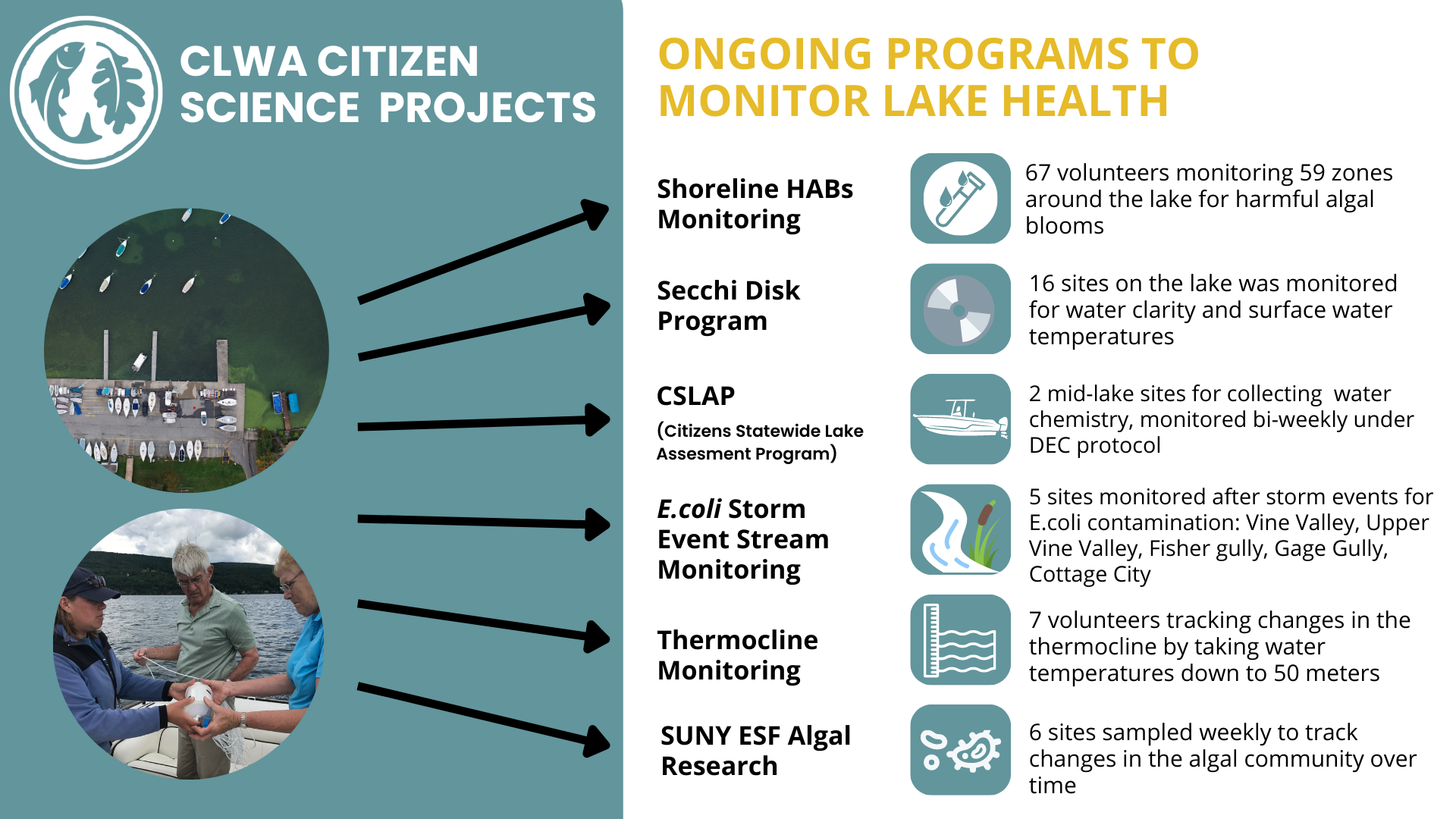
Today also marks the kickoff of the 2023 Volunteer Shoreline CyanoHABs Monitoring Program. This year, we have 66 volunteers monitoring 59 different zones around the lake, reporting weekly on their findings. CLWA volunteers are trained on how to identify, report, and sample harmful algal blooms, contributing to the overall monitoring and research efforts on Canandaigua Lake.
We are thrilled to have the support of many interested volunteers in helping to enable scientific research and collect top-notch data that is used to track trends and help make informed watershed management decisions. Below you will find a graphic of the projects that our Citizen Science Committee has running this summer. Thanks to all who are involved!

Each Friday, you will receive a weekly update summarizing the current lake conditions using reports from these ongoing research and monitoring programs. Updates are especially important when we are experiencing water quality concerns, so please help us spread the word by sharing updates with neighbors, family, and friends.

We kick off this summer’s first Weekly Water Quality Report with a review of this week’s significant flooding event and an update on the most recent water quality. This report was provided by Canandaigua Lake Watershed Council Watershed Program Manager, Kevin Olvany.
The storm of Sunday July 9th, 2023 will long be remembered for the devastation that it caused within parts of the Town and City of Canandaigua, along with some neighboring communities. Over 5 inches of rain fell within 3 hours in some parts of Canandaigua near the Airport and County Road 32. Thanks to all the reports submitted by community members, we were able to document that other areas of the Town and City of Canandaigua received anywhere from 2- 4+ inches of rain. If you were watching the radar and/or out in the storm, the rain just kept coming in waves of major intensity with little to no break between the waves. Gorham and Hopewell received anywhere from 1-3 inches of rain over a 1- 1.5 hour timeframe. When you look at the extreme precipitation tables for different storm durations- the areas in Canandaigua that had the 5+ inch totals exceed the 500 year storm event levels. The other areas in the Town and City were in the 50-100 year storm event levels. If that were not enough, we had 50-100 year storm events primarily in the Gorham and Hopewell area on June 12th and July 1st. July 3rd was a rain event that hit some some areas like Onanda Park very hard. Onanda Park lost its walking bridge that goes across Barnes Gully in the lower park.
With all that has happened over the last month (plus the April 5th storm that cause significant flooding in certain areas), we have seen tremendous amounts of runoff from the watershed entering the lake. After the major flood event of Sunday and resulting disaster declaration, the beach operators of Onanda, Butler, Kershaw and Deep Run beaches have been sampling for E. coli bacteria. E. coli bacteria is an indicator bacteria for the potential of various pathogens in the water that can cause human illness. Bacteria and pathogens primarily come from the intestines of warm blooded animals. The scientific literature documents that the main sources of bacteria are urban runoff, sanitary sewer cross connections, agricultural runoff along with animals living in the natural environment. The NYS Department of Health (DOH) sets a standard of 235 colonies of E. coli per 100mL. All of the regulated beach areas were well above this threshold when we tested on Monday and received the results on Tuesday. Press releases were put out to inform the public that the beaches were closed. Samples were then collected on Wednesday and all beaches were substantially lower with Onanda, Deep Run and Butler beaches being below the 235 threshold and Kershaw was slightly above it. We tested again on Thursday and the wind patterns played an important role in the results at Deep Run and Kershaw. One of the two samples at Deep Run exceeded the 235 E. coli count and Kershaw was also above the 235 E. coli regulatory threshold. There was a south/southwest wind that was concentrating the turbid water into the Deep Run area along with Kershaw. Onanda and Butler and the second Deep Run sample taken from the north swim zone were well below the threshold. Tests were collected today at Deep Run and Kershaw and the lab will provide results tomorrow (Saturday). The beaches visually looked better today than they did yesterday.
What does all this mean for the lake and recreating this weekend? The good news is that we are seeing the E. Coli levels substantially decreasing overall throughout the week. Some beaches are reopening. There are natural processes in place in the lake ecosystem that are causing the bacteria to reduce substantially. There seems to be a good correlation of visual turbidity in the water (brown looking) and E. coli levels. This is not suprising as the runoff from urban and agricultural areas are the primary drivers of E. coli levels. This is a natural ecosystem with many variables so you can never have zero risk- but the risk tends to be lower in clear water. We also tested for blue green algae (cyanobacteria) off-shore from the beaches and the test results showed no blue green algae (cyanobacteria). Reports from the CLWA shoreline volunteers and secchi disk volunteers are a valuable contribution to the overall monitoring efforts with watershed staff and researchers. Secchi disk reports coming in this week documented a significant decrease in clarity, an average of 3.3 meters. This is the lowest reported weekly average since the last week of August in 2017.
These have been huge precipitation events. In my 25 years of working here along with conversations with highway superintendents and long term residents this has been a unique rain year. I saw one news report on the weather channel that talked about the dual impacts of Climate Change and El-Nino potentially super charging these storm events. It sure feels that way. The local, county and state highway departments are hard a work trying to fix the damage in their road systems. Collectively, we are looking to partner with interested landowners to see if we can build more water quality and quantity resiliency into the watershed in order to reduce the magnitude of these extreme events. We can’t build infrastructure big enough for some of these events. We all have to do a better job of finding ways to build flood storage into the system and not build structures in flood prone areas.
Have a fun and safe weekend.
CLWA participates at public hearings and submits written comments to the respective town planning boards when we have concerns about proposed developments that have potential negative environmental impacts to the lake.
In the case of the proposed Scenic Ridge Rise subdivision (formerly named Spring Hill), CLWA had substantial concerns and provided verbal and written comments regarding the Draft Environmental Impact Statement to the Gorham Planning Board on February 21, 2022 and again on June 21, 2023.
CLWA’s letter submitted on June 21, 2023:
To: Town of Gorham Planning Board Chair, Thomas Harvey
From: Canandaigua Lake Watershed Association
Re: Canandaigua Lake Watershed Association comments for proposed lot 113.00-1-48.200 by Douglas Eldred (Scenic Ridge Rise)
Date: 20 June 2023
The Canandaigua Lake Watershed Association supports responsible development but opposes development which negatively affects the water quality of Canandaigua Lake. We have the following concerns with this application we believe the Planning Board should require the applicant to address.
We suggest the Planning Board determine what other areas of the site plan actually meet the requirements of the town’s Zoning Codes open space requirement and that the applicant be required to provide a plan with open space meeting the definition of the town’s regulations.
We suggest the planning Board direct the applicant to provide walking paths away from the buffer between this development and adjacent properties.
We suggest the Planning Board require delineation of the property lines on the lots and provide a barrier between the lots and the drainage structures. We also suggest the Planning Board control the timing of construction to ensure drainage facilities, including drainage swales located adjacent to residential lots, are constructed, stabilized and planted before land is disturbed for the construction of residences or other infrastructure.
We propose the Planning Board require the applicant to provide an option for pedestrian access to the Park that does not put pedestrians as close to traffic on Rt 364 or interfere with the access to houses on the west side of the road or with bicycle use of the shoulder. An access management plan should provide for sidewalks and pedestrian mobility as well as for automobile movement. We suggest the Planning Board require the applicant to provide an alternative access plan for pedestrians that doesn’t require walking on Rt 364.
We believe the Planning Board should carefully consider how to mitigate potential damage to the lake and Ontario Beach Park from runoff from this site during large storm events and also consider the potential liability to the Town when it accepts ownership of the subdivision road if substantial runoff damages property on the shore to the west. We encourage the Planning Board to direct the applicant to provide an optional layout where substantial stretches of the road run parallel to the slope and to Rt 364 to allow better interception of stormwater that can be expected from the impervious surface of the road and any development that empties onto the road.
We propose the Planning Board require existing trees that should be saved be tagged by an arborist and be preserved on the site during construction and that a planting plan for development ensure that, as houses are built, adequate landscaping is restored to help stabilize erodible soils and protect the viewshed of the site from the lake and its west shore.
Retaining site plan review as houses and accessory development occurs would mitigate the risk that appropriate landscaping will be left out of future development, and will ensure that development coverage limits are respected as the site is developed. We encourage the planning Board to retain site plan review for development of each lot on the site.
We are disappointed that, as the Town of Gorham updates its Comprehensive Plan, it has not reconsidered the very dense zoning along the east side of Route 364 or done an analysis of the potential for a full build-out of this area at currently zoned density to cause serious issues for the lake. Zoning this area rural residential, meant to provide a transitional area for low-density residential development between dense development adjacent to the lakeshore and farmland, would have gone some distance in allowing mitigation of deleterious effects of development on the lake while still allowing property owners to develop their land and provide for additional residential development in the town. This density of development on the property between this site and Turner Road could even more severely exacerbate stormwater and traffic issues. Such segmented environmental review provides little understanding of the overall impacts of this level of development on the lake.
In addition, the Town has not been successful in taking steps to adapt its stormwater management provisions in recognition of the increased intensity of storm events. Canandaigua Lake is a major driver for the local economy and lakeside housing is a very substantial part of the tax base for the town. Both deserve more consideration.
Thank you for the opportunity to comment on this application.
Sincerely,
Lynn Klotz
President, Board of Directors
CC: Town of Gorham Supervisor
CLWA Strategic Initiatives Committee Members
East Lake View Homeowners’ Association

If you participate in or follow the programs led by the Aquatic Citizen Science Committee, you have undoubtedly heard us use the phrase “eyes on the lake.” Those “eyes” refer to the nearly 80 volunteers CLWA relies on each year to crowdsource data collection to help us better understand and document trends in the water quality and watershed environment of Canandaigua Lake and advance research in cyanoHABS. Our Aquatic Citizen Science efforts are divided into two distinct groups of programs, namely our annually recurring programs and our research-directed projects.
The strength of our annually recurring programs, such as the Volunteer CyanoHAB Shoreline Monitoring, the Secchi Disk program, the CSLAP (Citizen Statewide Lake Assessment Program), and the new Temperature at Depth program allow us to provide timely public notification of lake conditions to our membership and the greater public, and build robust data sets. Though these data sets are frequently used by the NYSDEC and the Canandaigua Lake Watershed Council they are also shared and valued by researchers. Just this past year our 10-year Secchi disk data set was used by academic and commercial researchers to “ground truth” satellite measurements in the evolving field of remote sensing for monitoring and predicting cyanoHABS and potentially quantifying nutrient loading after a storm event.
What you may not have considered, is that our robust volunteer network also attracts researchers to do projects on our lake. By utilizing volunteers for sample and data collection, more frequent and spatially diverse data can be collected to support a research project. Volunteers can react in a more timely manner to current lake conditions than otherwise available to a researcher. The more volunteers that are engaged, the more data is collected and in this way, our volunteers become the scientists’ “eyes on the lake.” This depth of data collection is crucial in furthering researchers’ understanding of the drivers of cyanoHABS production within the complex ecosystem of our lake. The dedication of our volunteers puts us in this unique and fortunate position!
The focus of this newsletter is an in-depth look at our annually recurring programs with summaries provided by the Aquatic Citizen Science Committee members who help lead each program. A future newsletter will provide an in-depth look at the research-directed projects listed below.
The research-directed projects that the Aquatic Citizen Science Committee leads include:
We would like to thank all the volunteers that support our efforts, but especially the Aquatic Citizen Science Committee members who not only volunteer but actively lead each of these programs and CLWA staff who support us. This includes Susan Carpenter, Ted Carman, Dee Crofton, Nadia Harvieux, Lynn Klotz, Marty Lasher, Sally Napolitano, Joel Pasternack, and Lynn Thurston.
By Sally Napolitano, CLWA board Member, Chair of the aquatic citizen science committee

If you are having a hard time recalling last year’s harmful algal bloom (HABs) season, there might be a good reason why! Compared to previous years, CLWA water monitoring volunteers observed fewer cyanobacteria blooms (cyanoHABs) during the 11-week monitoring period last summer. With increased participation, 67 shoreline volunteers monitored 61 zones along the lake. Out of 404 observations submitted, only 33 blooms were documented, with the highest number in the Northeast/Central East regions. No blooms were reported in the southern portion of the lake.
Table 1. 2022 Canandaigua Lake Shoreline CyanoHABs Monitoring by Region

The 2022 algal bloom season on Canandaigua Lake had several reported blooms. The first was a small, localized shoreline bloom on August 16th in the northwest region. On September 9th, another shoreline bloom was reported in the northeast/central east area, with visual observations from six volunteers. Additional bloom activity occurred on September 17th and 18th, primarily in the northern half of the lake, with eight reports. Two smaller blooms were reported on September 24th and 30th, with four and three visual observations respectively. Unlike previous years, there were no lake-wide blooms. The majority of the reported blooms were identified as “small, localized,” and were confirmed by NYSDEC based on photos.
CLWA’s shoreline volunteer observations on cyanoHABs were shared in the weekly Water Quality Updates by CLWA and the Canandaigua Lake Watershed Council. These organizations rely on the valuable observations made by CLWA volunteers to keep the watershed community informed.
A total of 14 bloom samples were collected for microcystin testing at the Finger Lakes Institute in Geneva. Out of these samples, 12 had microcystin concentrations exceeding the USEPA recreational threshold of 4 μg/L. The concentrationsranged from 3.3 to 366.0 μg/L. It is worth noting that microcystins can persist even after a visible cyanobacterial bloom disappears, with a typical half-life of four to 14 days, influenced by factors such as photodegradation, bacteria, and organic matter. Ongoing research in the Finger Lakes region continues to focus on the persistence of microcystin toxins. CLWA is grateful to its dedicated volunteers and partners, including Seneca Lake Pure Waters Association (SLPWA), Canandaigua Lake Watershed Council, NYSDEC, and Finger Lakes Institute, for their continued support of the Shoreline CyanoHABs Volunteer Monitoring Program.
So what accounts for fewer observed blooms during the 2022 season? “We know many factors play a role in the development of cyanoHAB blooms, like, nutrient run-off, invasive species, (specifically dreissenid mussels which can release and recycle legacy nutrients), and climate change,” states CLWA Citizen Science Committee Chair Sally Napolitano. “The spring and summer of 2022 experienced “abnormally dry” conditions for much of our area according to the U.S. Drought Monitor. This may have denied the cyanobacteria much of the nutrients needed to fuel their growth for bloom development. Through our project with Greg Boyer at SUNY-ESF, we know Microcystis was present as early as June 14th, 2022 when we began our weekly sampling and imaging, but fortunately, their growth didn’t rise to the “bloom” level as early or as frequently as in past years. More research needs to be done to understand the role of both dreissenid mussels and nutrient pulses delivered by rain events and their impact on the formation of cyanoHABS.”
BY NADIA HARVIEUX , CITIZEN SCIENCE COMMITTEE MEMBER &
Associate Director of Educational Programs at hobart & william smith colleges
U.S. EPA. 2019. Recommended Human Health Recreational Ambient Water Quality Criteria or Swimming Advisories for Microcystins and Cylindrospermopsin. EPA Document Number: 822-R-19-001. Available from: https://www.epa.gov/sites/default/files/2019-05/documents/hh-rec-criteria-habs-document-2019.pdf

Canandaigua Lake Watershed Association (CLWA) has reviewed scores of scientific studies on neonicotinoid insecticides, with a focus on understanding the benefits and costs of these compounds to the economy and to the environment. We are convinced that the excessive and largely unnecessary use of neonicotinoid insecticides, particularly as a prophylactic seed coating for corn, soybean and wheat, threatens those resources. Our watershed must be protected, not only for ourselves but for future generations as well. After careful consideration, the CLWA Board of Directors has decided to support passage of the proposed Birds and Bees Protection Act (S1856), and we urge you to do so as well. Please see the addendum for our detailed examination of the issues and the scientific information that informed our decision.
We are mindful of the difficulties this legislation might impose on some farmers, and we know that you share our concerns. Many family farms already operate on thin profit margins, and they can ill afford to lose some percentage of their crops to insect pests. We recognize that passing this legislation will impose a big shift in the way the agricultural community farms their land, so we ask that you use your influence in the legislature to secure the resources farmers will need as they transition to using uncoated seeds and to employing alternative, environmentally sustainable, practices. Using insecticides as a prophylactic insurance policy is both an economically and environmentally unsound strategy, and we are convinced by the scientific evidence that it must cease, and be replaced by integrated pest management strategies.
You have always been a true champion for this region, and we are grateful for your tireless efforts in protecting the environmental as well as the economic resources of our state. Thank you for considering our opinion on the Birds and Bees Protection Act. We urge you to vote in favor of this important amendment to the New York Environmental Conservation Law. We will be calling your office soon, and hope to find a time to meet with you in person to discuss our position.
Respectfully,
Lynn Klotz
President, Board of Directors
CLWA Board of Directors:
Neil Atkins, Katrina Busch, Susan Carpenter, Dee Crofton, Linda Dworaczyk, Rob Gray, Susan Martenson, Douglas Merrill, Sally Napolitano, Joel Pasternack, Ellen Polimeni, Shaynee Rainbolt, Wade Sarkis
The Argument for Banning Select Neonicotinoids in New York
At the time of their development in the 1990s and early 2000s, neonicotinoids were viewed as a welcome replacement for the much more toxic and environmentally dangerous organophosphates, carbamates, and organochloride insecticides. Neonicotinoids have recognizable and irresistible benefits. They are systemic toxins, which means they are transported into all plant tissues and provide protection against a wide array of insect pests, a fact which can lead to a reduction in the number of insecticide applications in fields facing intense pest pressure. At reasonable concentrations, they target mainly insects and related taxa, and they are largely safe for many other species, including humans. Had they been used judiciously as one component of an integrated pest management (IPM) strategy, there would be no need to ban their use except under conditions where there are no other options readily available.
Instead, neonicotinoid-coated seeds were sold to farmers as an insurance policy against the possibility that their crops might become infested, even if that possibility was remote. Several national and international studies, including a very comprehensive report published in 2020 by a team of scientists at Cornell University, demonstrate that the economic benefits of corn and soybean seed coats are minimal at best, and are often beneficial only when a field endures high pressure from several pest species.1,2 That is not typical of New York farm fields. While they may protect a farm against an unanticipated insect attack, their benefits as an insurance policy against these relatively rare occurrences are grossly outweighed by the clear and unrelenting damage they inflict on the environment. There are occasions when neonicotinoid insecticides are the only course of action against invasive pests, like the spotted lantern fly and the hemlock wooly adelgid, which attack fruit and forest trees. This bill will not prohibit the use of these insecticides under emergency circumstances.
Point 1: Prophylactic seed and turf/ornamental plant treatments with neonicotinoid insecticides in the absence of an integrated pest management strategy is an economically and environmentally unsound practice
There are significant negative outcomes from the use of neonicotinoids in insect control. One is that non-target species (not insect pests) are adversely affected. Harmless insects, including our economically-vital pollinators, as well as useful insects that serve as biological controls of insect pests, are being lost in large and economically-unsustainable numbers.3 The numbers of birds and bird diversity are likewise threatened.4 The US EPA determined in 2022 that between 1,225 and 1,445 endangered plant and animal species (67-79%) are likely adversely affected by neonicotinoids.5
Since 90-95% of the insecticide applied to the seed coat remains in the soil instead of in the plant, it alters soil health, infiltrates nearby non-crop plants, and eventually washes into groundwater and surface water. Neonicotinoids degrade slowly, and they are persistent, so repeated use year after year creates toxic landscapes and waterscapes. One study shows that U.S. farmlands are now 48 times more toxic to all insect species than they were in the 1990s.6 Conservative estimates are that more than 90 tons of these insecticides accumulate in New York farmlands, green spaces, and bodies of water each year.1
Point 2: The New York landscape has become toxic to harmless and economically-beneficial species of insects, including pollinators that contribute $400 million to the NY economy
Because of their persistence and high-level water solubility, neonicotinoids are now prevalent in dangerously high concentrations in most lakes and streams in the U.S. and worldwide.7,8 The presence of these toxins is causing a loss of vital invertebrate species that form the foundation of the entire freshwater aquatic ecosystem, adversely affecting macroinvertebrates, fish, amphibians, birds and mammals.9,10 Furthermore, neonicotinoids have been detected worldwide in well water as well as raw and finished municipal drinking water. Recent studies show that most routine drinking water treatments remove only a fraction of neonicotinoids, and that significant removal requires advanced granular activated carbon filtration not available to many small and rural municipalities.11,12 There is some evidence to suggest that chlorinating certain neonicotinoid formulations may create more toxic end-products. Canandaigua Lake alone serves 78,000 residents with drinking water and supports millions of dollars in tax and tourist revenues. This resource is at risk.
Point 3: Neonicotinoid insecticides have entered the aquatic environment in high enough concentrations to threaten entire aquatic ecosystems as well as drinking water supplies
There is one additional argument for banning these products. A recent study showed that nearly 50% of human subjects tested, including children as young as three years of age, had urine samples that contained neonicotinoids.13 Earlier generations of insecticides were topical, and could be washed off the surfaces of fruits and vegetables. Systemic neonicotinoids infiltrate the plant tissues and are consumed when eaten. Studies of these compounds on experimental mammals suggest several potential health problems, including risks to human reproduction and the development of the brain, particularly in fetuses and children.14,15,16
Point 4: Due to their pervasiveness and high concentrations in food and water, neonicotinoids now pose a risk to human health
Neonicotinoids are banned in many European countries and in Canada, and there is little evidence at this time for adverse economic impacts.17 The NYSDEC has prohibited their use in some downstate counties due to water table concerns. The agency has banned one neonicotinoid formulation, chlothianidin, from being applied anywhere in NYS as a spray for agricultural, commercial and homeowner use because of concerns about groundwater contamination and risks to fish and wildlife. However, the agency is unable to restrict its use as a seed coat. The USEPA has chosen to provide all neonicotinoid seed coats with a FIFRA exemption as “treated articles or substances.” This means that nearly 70 tons (of the 90 ton
total) of neonicotinoid insecticides that enter NY soil and water each year from coated seeds cannot be regulated, or even monitored, as pesticides.18 The Birds and Bees Protection Act will close this loophole.
A ban on the use of neonicotinoid insecticides as defined by the Birds and Bees Protection Act will impose some hardships on some farmers and turf growers who believe they have few if any alternatives available to them. However, incorporating Integrated Pest Management (IPM) strategies have been proven to produce better crop yields than seed application while also significantly improving the welfare of pollinators, the quality of food, and the preservation of aquatic and terrestrial environments.19,20 The core feature of Integrated Pest Management is to use insecticides as a last resort, and only after the pests have been identified and it has been determined that they pose an undue economic penalty. Insecticides are then employed in a targeted, economically-feasible, and environmentally-sensitive fashion.21
Point 5: Alternatives to the unnecessary use of neonicotinoids do exist, and they need to be employed to protect the ecology and the economy of the Canandaigua Lake watershed
Weighing the largely insignificant economic benefits to New York farmers against the considerable environmental detriments, there is simply no good reason for farmers to continue to use neonicotinoid-treated corn, soybean and wheat seeds. A similar argument can be made for their use on turf and ornamental plants, unless environmental emergencies dictate their usage. The bill provides this safety measure.
References
1 Grout, T.A., et al., Neonicotinoid Insecticides in New York State: Economic Benefits and Risk to Pollinators. 2020. Cornell University.
2 Mourtzinis, S., et al., Neonicotinoid Seed Treatments of Soybean Provide Negligible Benefits to US Farmers. Nature Scientific Reports. 2019. 9:11207. https://www.nature.com/articles/s41598-019-47442-8.
3 Sanchez-Bayo, F., The Trouble with Neonicotinoids: Chronic Exposure to Widely Used Insecticides Kills Bees and Many Other Invertebrates. Science 14 November 2014. Vol, 346, No. 6211. Pp. 806-807. https://www.jstor.org/stable/24745155.
4 Eng, M., et al., A Neonicotinoid Insecticide Reduces Fueling and Delays Migration in Songbirds. Science. 13 September 2019. Vol. 365, 6458, pp.1177-1180. DOI: 10.1126/science.aaw9419.
5 United Stated Environmental Protection Agency Report: EPA Finalizes Biological Evaluations Assessing Potential Effects of Three Neonicotinoid Pesticides on Endangered Species. 2022. https://www.epa.gov/pesticides/epa-finalizes-biological-evaluations-assessing-potential-effects-three-neonicotinoid.
6 DiBartolomeis, M et al., An assessment of acute insecticide toxicity loading (AITL) of chemical pesticides used on agricultural land in the United States. PLoS One. 2019 Aug 6;14(8):e0220029. doi: 10.1371/journal.pone.0220029. PMID: 31386666; PMCID: PMC6684040.
7 Borsuah, J.F. et al., Literature Review: Global Neonicotinoid Insecticide Occurrence in Aquatic Environments. Water. 2020 12(12), 3388; https://doi.org/10.3390/w12123388.
8 Hladik, M.L., Kolpin, D.W., Kuivila, K.M., Widespread occurrence of neonicotinoid insecticides in streams in a high corn and soybean producing region, USA. Environ. Pollut. 2014, 193, 189–196.
9 Barmentlo, S. H. et al., Experimental Evidence for Neonicotinoid Driven Decline in Aquatic Emerging Insects. Proceedings of the National Academy of Sciences. October 25, 2021. https://doi.org/10.1073/pnas.2105692118.
10 Yamamuro, M., et al., Neonicotinoids Disrupt Aquatic Food webs and Decrease Fishery Yields. Science. 1 November 2019, Vol. 366, 6465. Pp. 620-623. DOI: 10.1126/science.aax3442.
11 Klarich, K.L., et al., Occurrence of Neonicotinoid Insecticides in Finished Drinking Water and Fate during Drinking Water Treatment. Environmental Science & Technology Letters. 2017, 4, 168-173. DOI: 10.1021/acs.estlett.7b00081.
12 Kim, J., et al., Concentrations and Distributions of Neonicotinoids in Drinking Water Treatment Plants in South Korea. Environmental Pollution. November 2021, Vol. 288. https://doi.org/10.1016/j.envpol.2021.117767.
13 Ospina, M., et al., Exposure to Neonicotinoid Insecticides in the U.S. General Population: Data from the 2015- https://doi.org/10.1016/j.envres.2019.108555.
14 Gu. U.H. et al., Reproductive Effects of Two Neonicotinoid Insecticides on Mouse Sperm Function and Early Embryonic development In Vitro. PLoS One. 2013 Jul 29; 8(7):e70112. doi: 10.1371/journal.pone.0070112. PMID: 23922925; PMCID: PMC3726447.
15 Cimino A.M. et al., Effects of Neonicotinoid Pesticide Exposure on Human Health: A Systematic Review. Environmental Health Perspectives. 2017, 125 (2). https://doi.org/10.1289/EHP515.
16 Zhao, G-P., et al., Toxicities of Neonicotinoid-Containing Pesticide Mixtures on Nontarget Organisms. Environmental Toxicology and Chemistry. 2020, 39 (10) pp. 1884-1893. DOI: 10.1002/etc.4842.
17 Kathage J. et al., The Impact of Restrictions on Neonicotinoid and Fipronil Insecticides on Pest Management in Maize, Oilseed rape and Sunflower in Eight European Union Regions. Pest Management Science. 2018 Jan;74(1):88-99. doi: 10.1002/ps.4715. Epub 2017 Oct 13. PMID: 28842940; PMCID: PMC5765491.
18 Jactel, H. et al., Alternatives to Neonicotinoids. Environment International. 2019. Vol. 129, pp. 423-429. https://doi.org/10.1016/j.envint.2019.04.045.
19 United States Environmental Protection Agency Report: EPA Response to the April 2017 Petition from Center for Food Safety and Others Relating to EPA Regulation of Pesticide-Treated Seed. 2022. https://www.regulations.gov/document/EPA-HQ-OPP-2018-0805-0104.
20 Pecenka, J.R., et al., IPM Reduces Insecticide Applications by 95% While Maintaining or Enhancing Crop Yields Through Wild Pollinator Conservation. Proceedings of the National Academy of Sciences. 2021. Vol. 118. https://doi.org/10.1073/pnas.2108429118.
21 U.S. Environmental Protection Agency Report: Integrated Pest Management (IPM) Principles. https://www.epa.gov/safepestcontrol/integrated-pest-management-ipm-principles.
