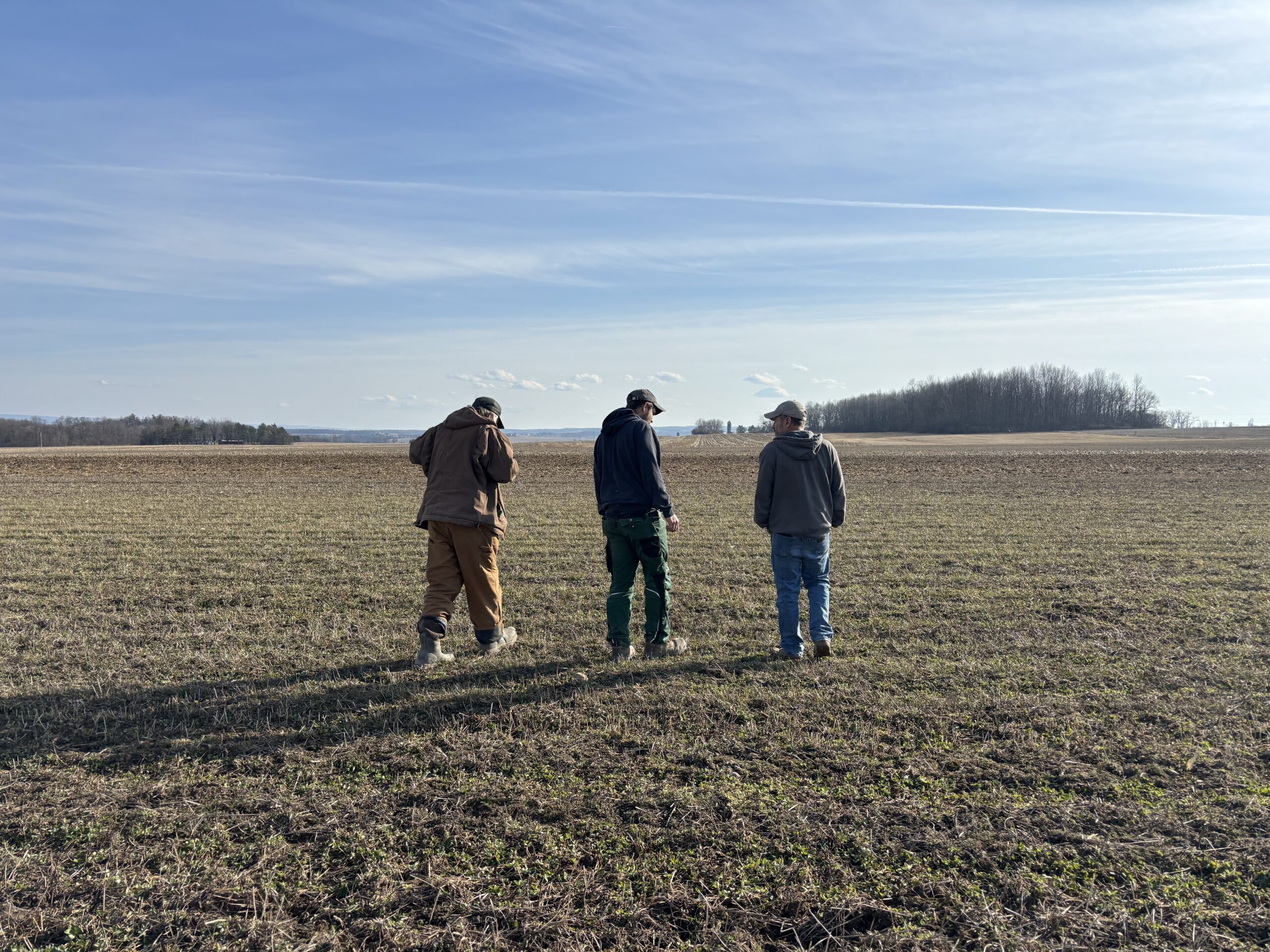
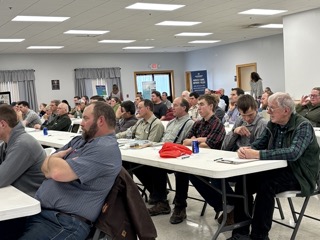
For several years, CLWA has partnered with the Soil and Water Conservation Districts of Ontario and Yates Counties to co-sponsor an annual Soil Health Workshop, held each February or March. The workshops provide an opportunity to learn about new programs and technologies available to farmers as well as complete certificates across several topics from pest control to manure management. CLWA’s participation has infused an emphasis on considering impacts on water quality and, this year, we secured a nationally-known speaker, Eric Fuchs from Understanding Ag (https://understandingag.com)!

Why does CLWA care about Ag? Our Lake Friendly Lawn Care / Living program has focused on reducing nutrient and pollution inputs from residential and municipal properties. With over 30,000 acres of farmland in the Canandaigua Lake watershed representing 28% of the land use, there is tremendous value in partnering with the agricultural community as well. The bottom line is that there is a direct correlation between healthy soil and clean water.


We learned about Understanding Ag after reading Gabe Brown’s book, Dirt To Soil: One Family’s Journey into Regenerative Agriculture. The consulting company provides “support and confidence to help clients reduce input costs, generate actual profits, and ensure family farming futures… accomplished by educating and mentoring farmers, ranchers, landowners, businesses, and communities in the principles and practices needed to restore, repair, rebuild, regenerate their farming and ranching ecosystems.”


For Eric’s visit to the watershed for the Soil Health workshop, we planned a comprehensive 3-day itinerary. On day 1, we toured the Martens’ family organic grain farm and state-of-the-art seed-sorting facility in Penn Yan, discussing soil health and the benefits of cover cropping. Day 2 featured a successful Soil Health workshop with 109 attendees, where Eric gave two talks on “Agricultur

e’s Role in Nonpoint Source Pollution” and “The 6 Principles of Soil Health.” Afterward, we visited the Horst family farm and enjoyed dinner with Mennonite friends at Finger Lakes Plates. On the final day, we had a productive breakfast session with resource providers from various organizations (Ontario & Yates Co Soil and Water Conservation Districts, Cornell Cooperative Extension, Seneca Lake Pure Waters, CLWA, CLWA supposed to be CLWC?), and concluded with a driving tour of water quality improvement project sites with Kevin Olvany, Watershed Manager.

Key Takeaways from Eric’s Visit:

  • Soil Health: Healthy soil has excellent structure, is rich in microorganisms, and retains moisture effectively.
  • Cover Cropping: Is essential to prevent erosion and degradation of soil quality. Bare fields erode easily and require costly amendments that may harm water quality.
  • Human Health: Is directly linked to how our food is grown and the soil quality.
  • Runoff Management: Runoff from buildings, fields, and livestock should be managed on-site to prevent contamination.
  • Tile Drains: Are likely overused in our watershed, necessitating reevaluation.

Eric was a wonderful guest and consultant, providing information of value to CLWA and our partner organizations. To learn more about Regenerative farming practices, see www.understandingag.com


Posted in Lake Friendly Living

Lake Friendly Property Tour

Shoreline Stewards: Molly & Ed Shill

Join us on the East Side of Canandaigua Lake as we explore a lake-friendly property. From eco-conscious landscaping to innovative stormwater management, discover how sustainable shoreline development can help support biodiversity and clean water.

There are many things that people living on and off of the lake can do to create more lake-friendly properties. But what is lake-friendly anyway?

Lake Friendly Living is a program designed to help educate residents and businesses about best practices for lawn care, landscaping, building practices, and waste removal. A great place to begin learning about Lake Friendly Living is by reading our Lake Friendly Living Guide. This will help you start your journey to consider the lake daily.

LAKE FRIENDLY LIVING GUIDE

Rain gardens are a landscape design feature that can help keep Canandaigua Lake clean, especially during heavy rainfall.

Here are just a few benefits of rain gardens: 

  • Natural Filtration: Rain gardens act as natural filters, capturing and absorbing stormwater runoff before it enters the lake.
  • Reduce Erosion: By slowing down the flow of water, rain gardens help prevent soil erosion, which can carry pollutants into the lake.
  • Nutrient Removal: Plants in rain gardens uptake nutrients like nitrogen and phosphorus, which are common pollutants in stormwater runoff, thereby reducing their impact on lake water quality.
  • Promote Infiltration: Rain gardens allow stormwater to infiltrate into the soil, replenishing groundwater supplies and reducing the volume of runoff reaching the lake.
  • Habitat Creation: Rain gardens provide habitat for various wildlife, including birds, butterflies, and beneficial insects, enhancing biodiversity and ecological resilience along the lake’s shoreline.

We recommend reaching out to a professional landscape architect, such as Gabrielle Fladd, who can guide you through the process of calculating your runoff and drainage needs.

Have questions or want to learn more? Give us a call and we can try to help get you connected with the right people to help you with your Lake Friendly Living designs!

Posted in Lake Friendly Living Tagged with:

Winter 2024 Newsletter


2024/Winter Newsletter by CLWA

Posted in News

Saving the Hemlocks: One Member’s Story to Protect a Family Camp

Saving the Hemlocks: One Member’s Story to Protect a Family Camp

CLWA is pleased to feature this article penned by CLWA Member Bill Hochadel. 

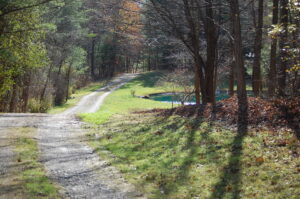
As I pull onto our driveway off Monks Rd. I so look forward to a slow drive for the next ¾ of a mile into “Camp”. I start down a slight grade of the driveway that takes me past a swamp area to the left and now a wooded area of young ash, maples, and pines compared to the old-growth woods farther in. When I first started coming to this property 55 years ago, there were no ash or maples there, but there were scrub pines in a field where my future father-in-law, as a kid, would bring the cows to graze from the family farm on the other side of Seneca Point Gorge.

Each ride into Camp reminds me of all the generations, five now since I have been around, that have camped, hiked, Xcountry skied, rode various all-terrain vehicles, and hunted on this property. Shortly after you descend the grade of the driveway, to the right we now have a pond that is enjoyed by family members who camp near and swim. It has been stocked with fish and is ready for the younger generations to ready their poles.

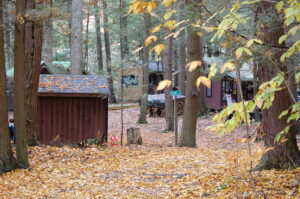
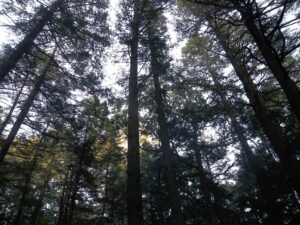
When I finally arrive at the “Camp”, I’m now nestled in the midst of mostly some very mature hemlocks and a few white oaks that provide a canopy over the buildings which protect them as well as a sanctuary for all the birds and animals. The canopy also provides cooler temps in the summer when our family camp is utilized more often nowadays. Not 30 feet from where I park, I can look into Seneca Point Gorge. I can view the thousands of mature hemlocks as well as the sight and sounds of the stream and a waterfall, 150 feet down, and before it empties into Canandaigua Lake. It is very beautiful and relaxing.

Unfortunately, I have been watching the hemlock canopy thin out and dissipate the last few years. Our property has been heavily infested with the Hemlock Woolly Adelgid and we are losing that canopy fast. I’ve already noticed that in the summer it’s not as cool as in the past and there is much more light coming through with more and more dead branches. It is not conducive for maintaining the ambiance of “Camp” and as a continued wildlife sanctuary.

In the fall of 2022 we partnered with Jim Engle of White Oak Nursery. With his commitment and the approved pesticide he has treated thousands of the infected hemlocks. We concentrated first in the family “Camp” location and then started working in the outlying areas. The overall expense is not cost prohibitive especially when one looks at the overall cost of not treating. I can’t even imagine what it would cost the lake’s watershed and how our family “Camp”, a destination that has been favored for > 150 years, would look and be used if we were to lose all of these beautiful hemlocks. Seneca Point Gorge alone would look so different if all the hemlocks along its banks were dead in the next 10 years. We can only hope we were on time. There is much more that needs to be done.

-William Hochadel


For more information and resources on HWA in the Canandaigua Lake Watershed, visit: https://www.canandaigualakeassoc.org/education-outreach/hemlock-woolly-adlegid/

Posted in Terrestrial Invasive Species

Storm Event Water Quality Testing for E. coli in Streams Feeding Canandaigua Lake

Storm Event Water Quality Testing for E. coli in Streams Feeding Canandaigua Lake

CLWA volunteers, trained by Community Science Institute (CSI), Ithaca, NY collected samples from streams draining into Canandaigua Lake during 2021, 2022 and 2023. Samples were collected and kept cold on wet ice and delivered to the CSI lab to be tested for E. coli within 24 hours of collection. Various parameters were recorded at the time of testing and chain of title was provided. CSI is NY State certified to test both potable and non-potable water for E. coli.

The initial plan was to collect 6 samples from spring until fall after storm events in 2021, but most of the streams identified for testing were dry that summer except during large storm events and we were able to sample only 3 times, on March 23 (28 for Seneca Point), July 18 and October 21. We sampled again on August 24 in 2022 and on April 18 and June 13 in 2023. In addition, I have included in the spreadsheet of results from limited testing conducted on August 28 of 2020 prior to this grant-funded research. Those tests were taken to Lozier Environmental Consulting, in Rochester NY, also a NY State Certified lab for non-potable water testing for E. coli.
The location coordinates for testing sites are in the CSI database with our test results for this project.

Yates County- description of streams sampled
Attempts to sample a stream draining Bare Hill were not successful due to lack of any water in those streams on any sampling date.
The Vine Valley stream was sampled where it runs under Dinehart Road, about halfway between there and where it drains into the lake (on private property not near a road), at the mouth of the stream and at the public beach. Sites were chosen on this stream to catch samples directly from agricultural land, again as it was diluted by largely forested adjacent slopes and at the mouth of the lake after it drained residential property known to have problematic septic systems. The swim area was sampled to determine if E. coli contamination impacted areas used for public recreation.
The West River, Naples Creek and Grimes Glem were each sampled one time.

Ontario County- description of streams tested
The stream at Deep Run was sampled where it crosses Rt 364 and in the public beach within the roped off swim area in about knee-deep water. The swim area was not sampled when there were large flocks of geese in the water and at the outwash delta due to likely in lake contamination and on one occasion where the flow in the stream was so low the water at the stream mouth was largely backwashed by lake water.
The Gage Gully stream where it crosses County Rd 11 (by the pump station), the first stream south of Cottage City Road on Lake Drive in Cottage City as it runs under Lake Drive, and the stream directly north of the Martin farm where it crossed Rt 364 were sampled on all sampling dates that they had running water. Jones Road at County Rd 11 was sampled on one occasion.
The stream at Seneca Point was sampled directly above the Bristol Harbor wastewater treatment plant, at the treatment plant outflow and just below where the stream crosses Seneca Point Road in order to determine the levels of E. coli coming from the treatment plant and their likely levels closer to where the stream enters the lake.

Results:
This project was intended to look at the health and safety of water with potential E. coli contamination in streams draining into Canandaigua Lake passing through and close by residential properties and to consider whether E. Coli in these streams might be contaminating near-shore areas used for swimming. In addition, where the shoreline is entirely on sewers, samples were taken along the road just before the streams cross into residential property.
We found that, although on many occasion streams had low or non-detectible levels of E. coli, after heavy storms some streams had extremely high levels and one public beach (Deep Run), very close to the mouth of a highly contaminated stream, had levels far exceeding safe recreational levels. On two occasions when our samples showed the public beach at Deep Run to be highly contaminated, it was open to the public for swimming with no warnings posted. The public beach at Vine Valley, which is not as close to the stream outlet, was not above safe recreational levels on any sampling occasion. It cannot be determined from our sampling if that is due to the distance from the mouth of the stream or the lake currents at that location. Further testing of shoreline areas near the mouth of streams likely to be contaminated after heavy storm events would help determine if and where swimming along the lake shore after a heavy rain is likely to be a health hazard. While much of the likely affected beach area is privately owned and not a public responsibility, it is heavily used for recreation and public warnings could be a public health benefit.

The extreme difference in E. coli levels in many streams between heavy storm events in April and June of 2023 indicated that the likely source of the contamination in most streams was from agricultural land, probably recently spread with manure. The low levels in April indicated that septic systems were unlikely to be the source in those streams. However, in October 2021 the Vine Valley stream had a higher E. coli count at the mouth of the stream than upstream where it drains directly from an agricultural field. One likely explanation is that the stream is being contaminated by septic fields as it runs down North Vine Valley Road, through Indian Village and the trailer park at Vine Valley. The water in the stream at that time was largely ground water derived since recent precipitation was fairly light and had largely infiltrated and there was no flow upstream near agricultural fields. Further sampling immediately upstream of these septic systems and at the mouth of the stream could document any improvement in water quality due to recent upgrades at Indian Village. The contamination found in October 2021 likely dissipated quickly as it was diluted by the lake due to very low flow and relatively low E. coli levels.
Samples at Seneca Point indicated that at the current time, given current levels of input to the treatment plant, the stream was mostly within safe levels of E. coli. There was one sampling occasion where the treatment plant effluent was high in E. coli but levels returned to close to safe recreational levels before they reached the lake. More consistent testing of the effluent could be warranted.

Further sampling recommendations
The primarily conclusions from this sampling are that streams from agricultural fields should be monitored more closely for E. coli after heavy precipitation events, especially during the spring and summer, as the streams could be a threat to public health if they are accessed by people or pets as they flow through residential areas, and that shoreline recreation near streams likely to have high levels of contamination should be sampled to determine how quickly contaminated stream water mixes with lake water to dilute bacterial levels to a safe recreational level. The Deep Run public beach should be more closely monitored for contamination after storm events to ensure people using that beach are not exposed to unsafe bacterial contamination.
Further segmented sampling from highly contaminated streams could determine the actual source of contamination, and water draining directly from field drains could be sampled to determine whether manure deposited on fields over tile drainage is contaminating road side ditches.
In some streams, especially where streams drain residential areas or in lake shoreline sampling, eDNA analysis could be helpful in determining the species of the source of the contamination.

Posted in Lake Monitoring, Water Quality Updates Tagged with: ,

Water and Wildlife Summer Camp Recap, by Lynn Ocorr, Watershed Educator

The camp was jam-packed and abuzz with activities to keep pace with the energy of young teens, grades 6- rising 9th graders. This year’s Water and Wildlife Camp went for 2 weeks; both half days. Each day was filled with hands-on lessons that gave the campers the tools to be more in tune with and equipped with how to protect the Canandaigua Lake Watershed. Of course, mixed into these lessons were snacks and games! By every measure on our evaluation sheets, the camp was a success. The first week was similar to last year where the campers explored the streams. They analyzed all the streams around the lake transported by a bus from the Fitzgerald Bus Tours. Their luxurious tour bus amazed us all and we felt like celebrities while we rode from stream to stream collecting water samples and macroinvertebrates for analysis. Although the data isn’t exact (due to kids having too much fun!) and the campers did not exactly follow protocol, we did determine that the stream at Onanda Park seemed to have the lowest water quality. The biodiversity was low and we did not find any sensitive macroinvertebrates. It is worth noting that the water levels were much lower than our other sample sites, but it is also worth noting that the amount of invasive jumping worms was alarming. Normally when we hike the stream, salamanders and crayfish are easy to find; but not this year! We again invited Matt Gallo from Finger Lakes PRISM at Hobart William Smith College to expand on the topic of these invasive species. He explained why invasive species are interfering with local ecosystems and led the campers on a hike to collect and remove invasive plants like Japanese knotweed, honeysuckle, buckthorn, phragmites, purple loosestrife, giant hogweed, and garlic mustard. Again, invasive plants were found to be abundant along the stream bed. The good news: chemical analysis of the water in all the streams showed them all to be in great shape!

The second week was all new! The focus was on the vertebrates in the lake. This was complemented by the generous donation of a pontoon boat by the local Freedom Boat Club, which is owned and operated by Seager Marine. College level sampling equipment including bottom dredges, deep water van dorn samplers, top water plankton tows and secchi discs for water clarity were used to collect water samples at four different locations chosen by the campers. The campers chose to compare the effects of shoreline activity on water quality. They collected samples from shorelines that had highly manicured lawns, ample boat activity, or were close to road runoff. When these samples were compared to water from the center of the lake, it did indicate that high boat activity had some effect on plankton diversity. In addition to the boat trip, the DEC came to the camp with electroshocking equipment and dragged nets to collect fish samples on the shoreline.

Live samples of small mouth bass, perch, rock bass, bullheads, sunfish and bluegills were all examined and compared. Additionally, students learned how to tie jigs, fly fish, and filet fish. The camp ended with a Wildlife Rehabilitator, Rachel Tindal, who brought in squirrels that she bottle-fed while explaining the duties of a rehabilitator and the process of becoming one.

The success of the camp allowed us to receive the Guido and Ellen Palma Foundation Grant for a second year. This will allow us to expand the camp to a full day, 9 AM-3 PM, with a before and after care option from 8 AM-4 PM for next year. It was unanimous feedback that what the campers liked most was the chance to do “real science!” In response, we plan to add more data collecting equipment for August 2024. We had 4 campers who attended for the second summer. One repeater exclaimed, “I would come every year because the environment changes and what we discover changes!” The instructors include Jami Anderson, a teacher from the Canandaigua Middle School; Abby Zanowick, a teacher from the Canandaigua Academy and myself an adjunct professor at FLCC. We work hard to find the balance of fun, education and inspiration to enrich our campers’ lives. Registration for the 2024 Water and Wildlife Summer Camp for middle schoolers will start in early 2024 and the camp will be held August 12th-17th. We look forward to meeting the next round of campers!

Posted in Education Tagged with:

Trout in the Classroom (TIC)

Another endeavor the WEP has taken on this school year, is helping to support the local Trout in the Classroom (TIC) program that is run by the Canandaigua Trout Unlimited (TU) group. Environmental education and stewardship are some of the shared goals of our organizations and both missions involve protecting and restoring our local watershed, so when we were approached by TU members Mike Linse and Andy Yudichak on the idea of assisting them on this project, we were excited for the opportunity. Some of TU’s work in the community has involved trash clean-ups and reforestation efforts along our local waterways, running the local fishing derby on Canandaigua Lake, providing fishing equipment to the Wood Library, and offering fly fishing and fly-tying classes to community members.

TIC is a very successful national program serving grades K-12, and in NY alone, 250 different schools participate. Starting in the Fall, TIC participants raise trout from eggs to fry and in early spring, the goal is to release them into local rivers or streams. During the course of this engaging and experiential project, students will have the opportunity to feed the trout, monitor water temperature and chemistry, learn about water quality and watershed topics, as well as have opportunities for possible field trips with environmental professionals. This is a unique educational program that teaches students the importance of protecting land and water resources and has the potential to instill a desire for them to be environmental stewards throughout their lifetime. For more information on the local TIC program please visit www.smore.com/ry2q4 and for more on the national program, visit www.troutintheclassroom.org/ .

The WEP will offer educational classes to TIC program participants on watershed topics as requested by the teachers. Currently there are two districts involved, Jon Pragle’s classroom at Marcus Whitman, and Jon Betrus’ at Naples. Both are high school teachers. To see Jon Pragle’s trout tank in action visit the homepage of the Marcus Whitman School district at www.mwcsd.org, then click on quick links at the top right corner, followed by the link labeled Mr. Pragle’s Trout Cam.

Posted in Education Tagged with:

Update on Canandaigua Lake Blooms – October 4, 2023

On Monday, October 2nd, and Tuesday, October 3rd, Canandaigua Lake experienced a significant widespread cyanobacterial harmful algal bloom (cyanoHAB) event. Blooms were found along many shoreline areas- on the east side from Vine Valley north and the west side from Menteth Point north. There were also several open water areas experiencing blooms. All that “green” generated a lot of interest about water quality and as a result, we have had many new subscribers to our e-newsletter. Welcome to our new followers!

While we don’t often send out reports mid-week, we thought we’d share a follow-up to Monday’s water quality notification.


Between Monday and Tuesday, our trained cyanoHABs volunteers responded swiftly, providing 51 reports from around the lake. Seventy-four (74%) of reporters saw HABs in their area. We also had dozens of reports come in from the public, reporting areas of surface streaking, green-colored water, and surface scum. Volunteers collected 19 samples to track blue-green (cyano)chlorophyll and toxin levels and samples were sent to the Finger Lakes Institute yesterday. We just received the cyanoChlorophyll, which can be found below. Toxin results are not yet available.


Based on the above results, all but one of the samples collected had cyanoChlorophyll levels above the DEC 25 ug/L (micrograms per liter) threshold for a bloom. The one sample in the Cottage City area showed some of the highest levels we have recorded in recent years.

Our municipal partners acted quickly on Monday and roped off the public access areas where blooms were forming, as this is where pets and people swim. We thank them for their attention to this matter. The Canandaigua Lake Watershed Council has also been surveying shoreline areas and actively researching the migration of cyanoHABs throughout the water column.

Your “Need to Knows”.

While it is frustrating not to know when and where the blooms will be at any given time, we need to keep in mind that the lake is a living, changing ecosystem influenced by many factors, including wind patterns, water temperatures, weather, nutrient inputs, and impacts from invasive species. Read more about contributing factors here. Some areas of the lake may look pea-soup green, and others may be clear, as was the case this week. Remember: Lake conditions may change hourly. This means it is impossible to pinpoint when and where a bloom may pop up and where it will be “safe” to recreate. The best course of action for this is to educate yourself, your friends, and your family on what to look for and how to avoid it. While it is very hot and tempting to swim, please keep pets and people out of waters with visible signs of surface streaking or discolored, green water.

Today (Wednesday, 10/4) we have not had as many reports come in, although there are still blooms out there. Winds picked up slightly today, and surface waters are mixing. Secchi disk water clarity results also look good – we have not had a huge drop in overall clarity, which is promising.

Please continue to keep an eye out for signs of HABs as the sunny, warm conditions continue this week.

Please email HABs@canandaigualakeassoc.org with any questions.

Posted in Water Quality Updates

Widespread Blooms Reported on Monday, October 2, 2023

We have received several reports of cyanobacterial harmful algal blooms (cyanoHABs) along the shoreline of Canandaigua Lake today. Areas reporting blooms include Vine Valley, Deep Run, Ontario Beach Park, Kershaw Park, and many private residences. We also received a report of a bloom area mid-lake as well.

Please avoid swimming or letting pets swim in blooms. Based on previous results, we know that blooms can produce high toxins, so please exercise caution and avoid areas with green discolored water, surface streaking, a pea-soup-like appearance, or scums. Several public access areas have been roped off to protect public health.

Please email HABs@canandaigualakeassoc.org with any questions.


Posted in Water Quality Updates

Water Quality Update for September 22, 2023

Volunteers logged a total of 70 shoreline surveys this week (reporting week from 9/15 – 9/21), 13 of which were bloom reports. The vast majority of the bloom reports came through on Wednesday, 9/19 and Thursday, 9/20 and were reported as small to large localized blooms. Volunteers reported areas of surface streaking, in some cases rather heavy.

This is the time of year we may see isolated blooms when the conditions are just right – dead calm winds are an early indicator that cyanoHABs may pop up.
We received the certified toxin results from the blooms that were reported the week after Labor Day- when Canandaigua Lake had its first significant outbreak of the season. Analysis was run for microcystin (the toxin associated with cyanobacterial blooms) from several bloom samples collected on 9/6 an 9/7.

We do not run toxin analysis on every sample collected during HABs season, but we find value in running this analysis for the first major bloom of the season. We strive to get a variety of conditions, from open water to light blooms, to major pea soup-like conditions. Results from this sampling round in early September did have detectable toxins, in most cases the shoreline areas were over the DEC threshold for “high toxins.” This further reiterates that blooms should be avoided to protect public health.

Our municipal water purveyors have been routinely testing public drinking water supplies for the microcyston toxin and all results have come back as “Not Detect”. Please see write up below for further information on cyanoHABs and drinking water.
Please continue to use your visual indicators to look for signs of an active bloom situation before recreating in the lake- surface streaking, green, discolored water, or surface scums. Calm days (no wind) seem to be more favorable for the rapid proliferation of cyanobacteria and resulting blooms. Please email HABs@canandaigualakeassoc.org with any questions you have.

Drinking Water Testing
Our five municipal water purveyors (the City of Canandaigua, the Village of Newark, the Village of Palmyra, the Village of Rushville, the Town of Gorham) are working alongside the Geneva District Office of the Health Department and the New York State Department of Health to monitor the public drinking water for the presence of toxins associated with harmful algal blooms. Water quality information and data is exchanged between the water purveyors, health departments, and our local watershed groups (the Canandaigua Lake Watershed Council and CLWA) to keep all partners up to date on the current lake conditions. All results from this summer’s toxin testing of municipal systems have so far come back as non-detects. CLWA publishes the weekly results on our website, and the results can be found here. We also maintain a webpage with information for both municipal systems and for private water system users, which can be found here.
Read more about cyanoHABs and Drinking Water


Posted in Water Quality Updates