
|
|
|
|
|
|
|
|

|
|
|
|
|

|
|
|
|
|
|
|
|
|
|
|
|
|

Special contribution by Doug Llewellyn
This is the second in a series of informative articles by the CLWA Outreach and Education Committee, designed to offer practical approaches to Lake-Friendly Living.
As watershed residents, we all share the responsibility of protecting the health of Canandaigua Lake for generations to come. One important step is understanding the difference between sanitary and storm sewers. When leaves, lawn clippings, and road litter wash into storm drains, they can degrade water quality. By knowing how these systems work, we can make informed decisions about what shouldn’t enter our sewers, creating a less harmful impact on our watershed.
A sanitary sewer has a full cover (often termed a “man-hole cover”) secured flat to its circular rim at the surface of the road. The purpose of the sanitary sewer is to move wastewater from residential and commercial properties to a treatment facility. However, there are several things to know before flushing objects down the toilet. You should never flush baby or hand wipes (even the flushable ones) down a toilet. These wipes do not easily disintegrate. They cause clogged drains and pipes, resulting in backups and costly repairs to the Town’s Public Works System.
Other non-dissolvable products that should not be flushed down the drain or toilet includes diapers, feminine hygiene products, any greasy or oily food wastes, cotton swabs and plastic products, medications, cigarette butts, hair, gum, coffee grounds, egg shells, or dental floss.
The storm drains, on the other hand, have a grate cover that acts like a screen to block large items (such as twigs and small tree branches) from draining down the opening. Storm sewers handle runoff from heavy rains, melting snow, and water from surrounding streets and driveways. Storm sewers move water through a network of channels from its drainage site to a natural body of water – usually a stream, river, retention pond, or lake. Since much of the untreated water from the storm sewers ends up in our lake, residents should pay particular attention to reduce or prevent what gets washed into the storm sewer.
Here are just a few suggestions to help our watershed surroundings:
Now that we know more about sanitary and storm sewers, let’s all work together to become mindful of ways to help safeguard our treasured watershed and keep it healthy for our children, our grandchildren, and generations to come.

Folks of a certain age remember pulling drinking water directly from the lake with nary a care. Most homeowners with private drinking water systems have since added UV lights and filters.
New threats — cyanobacteria and PFAS chemicals — require homeowners to consider updated water purification. Chemical engineer and longtime South Bristol resident Dr. Bruce Capron defines these threats and suggests ways to help address them.
Until recently, living on Canandaigua Lake and drinking its water, it was considered sufficient for a private water system to filter sediment and particles and have a method to kill microbes such as E.coli.
Today, homeowners must go a step farther to remove toxins such as blue-green algae and plasticizer chemicals. This requires considering updated water purification for potential contaminants.
Let’s look first at blue-green algae. Because they can cause illness to people and pets, CLWA volunteers monitor around the lake and CLWA disseminates bloom reports each summer. These algae are a group of photosynthetic bacteria called cyanobacteria. Different species of these bacteria can produce cyanotoxins. Different cyanotoxins can damage the liver (hepatotoxins), the nervous system (neurotoxins), or can impact the functioning of cells (cytotoxins).[1] For freshwater, the most common cyanotoxins are microcystins (hepatotoxins) and anatoxins (neurotoxins). [2]
 There have been over 250 microcystin identified. The primary toxin identified and studied is Microcystin-LR. This is a molecule of seven amino acids and has a molecular weight of 995 g/mole. The size of this molecule has been estimated at 1.2nm to 2.6nm. [3]
Literature studies indicate the anatoxin are not as widespread as microcystins and do not pose the same level of risk. [4] However, the anatoxin molecules have a molecular weight of 254 g/mole and are assumed to be smaller in size than the microcystin molecules.
Although the size of cyanobacteria is in the range of 2 to 7 microns, the size of the cyanotoxin molecules found within these bacteria are more than 1000 times smaller (1 nanometer = 0.001 microns).
Even though the bacteria can be captured by relatively large filter media (e.g., 1 micron filter), it is important to note that the cyanotoxin molecules can be released outside of the bacteria’s cell membrane in living bacterium or released when the cell membrane is broken when the bacterium dies or during a water treatment process.
General filtration with cartridges removes particles by forcing the water through a porous media (e.g., paper) where most particles of a larger size are prevented from passing through the filter media.
This type of filtration is commonly used to remove sediment and other contaminants that are 1 micron or larger in size. As noted above, the toxin molecules and molecules commonly associated with plastics are nearly 1000 times smaller. Therefore, some form of nanofiltration is needed to remove these molecules.
The news is often filled with the term “microplastics”. These are small particles of various plastics found in everyday items. Although the health risks of microplastics are under debate, a more serious concern are families of chemicals that are associated with plastics, food containers, cookware, and food packaging.
Bisphenols: The most common bisphenol is BPA [5]. This is often used to make plastics harder and more durable. The BPA molecule (C15H16O2) is weakly soluble in water and tends to form colloidal particles that are greater than 90nm in size. Studies have shown that reverse osmosis and nanofiltration membranes are effective in removing BPA from water. [6]
PFAS: Polyfluoroalkyl substances (PFAS) are a large family of Polyflouro alkayline chemicals. Consumer Reports list some of the most common PFAS chemicals — PFOA, PFOS, GenX, and PTFE (Teflon). These are chemicals used as surface treatments for plastics, cloth, paper, cardboard, and metal. [7]
The EPA indicates that both activated carbon filtration and reverse osmosis systems are effective in removing PFAS chemicals. [8]
Phthalates: Phthalates are groups of chemicals used as plasticizers to make various plastics more flexible. Certain phthalates have been shown to be endocrine disrupters. One common phthalate is DEHP. (Consumer Reports, May 29, 2024). DEHP has a chemical formula of C24H38O4 and a molecular weight of 390.5 g/mole.
 Removing these chemicals from water requires some form of nanofiltration. The two most common forms are the use of activated carbon filtration and reverse osmosis.
Activated Carbon Filtration: Granulated Activated Carbon (GAC filters are typically manufactured by heating wood or coconut husks to create millions of small pores with an extremely large surface area.
A single gram of GAC material may have over 1000 square meters of surface area made containing small pores ranging from 0.5nm to 1000nm. [9] These filters remove contaminants from water when a contaminant molecule prefers to “stick” to the carbon material rather than remain in solution in water. This process is called adsorption.
For these filters to function, the water must spend sufficient time in the filter media for contaminant molecules to find an active site within the carbon matrix. Also, the effectiveness of these filters decreases with use as active adsorption sites are filled with contaminant molecules.
Activated carbon filters are commonly used in municipal water treatment facilities and many home systems. The challenge for residents that use lake water is to determine what size filter to use, how often to change the filter, and what level of the contaminants being discussed in this article are removed. (These questions might be answered if the text of the NSF 42 standard were available.)
Reverse Osmosis (RO): Reverse osmosis systems remove contaminants from water by using pressure to force water through a fine membrane. Of all the water filtration options, RO membranes have the smallest pore size distribution ranging from 0.1nm to 1nm, which is small enough to remove the contaminants discussed in this article.
Water and contaminants that do not pass through the membrane are rejected and go directly to the drain. Only the “permeate” stream is used as drinking water.
Most RO systems available to homeowners include a series of prefilters to remove sediment or contaminants that could load the RO membrane and reduce its useful life. These systems commonly include an activated carbon filter as one of the pre-filters.
In the most common, the RO system purifies water and sends it to a storage tank. When the faucet is open, the water in the tank is available and will flow. As the water is used and the pressure in the storage tank drops, the RO system will begin refilling the tank.
The time required to fill the tank will depend on the pressure in the feed water line and size of the system. Homeowners who need more instantaneous capacity can install a larger storage tank or run a second tank in parallel.
The second type of RO system is a continuous flow system. These systems may include an integrated booster pump and a larger membrane to provide water continuously when the tap is open.
One metric of a RO system is the ratio of purified water to wastewater. This can range anywhere from generating two gallons of wastewater per gallon of purified water to 0.5 gallons of wastewater to purified water. Some systems are installed with a permeate pump. This is a hydraulic pump that uses the pressure in the wastewater stream to help pump the purified water into a storage tank.
Homeowners should also be aware that many manufacturers develop the specifications for their systems based on assuming a constant water pressure of 60 psi. Homeowners with submersible pumps will likely have higher pressure in their cottages than homeowners using a “jet” pump. For those cottages with low water pressure, booster pumps can be installed in the feed water line to the RO system to increase the pressure across the RO membrane and improve the recovery time and flow rate.
As cyanobacteria and PFOS impact the water quality of the Finger Lakes, homeowners with private drinking water systems have options for upgrading to remove these new threats.
Bruce Capron earned his Ph.D. in Chemical Engineering from the University of California, Berkley. He has worked in engineering and business management positions in the optoelectronics, optics, laser, and medical device industries. Inspired by his work as a school board member, from 2001 to 2009. Capron earned a master’s in educational administration. He retired as Assistant Superintendent for Business and Operations, Honeoye Falls-Lima School District in October 2022. He is adjunct professor at SUNY Brockport, where he teaches data analytics to school administrators.
Editor’s Note: Several area companies have kept pace with new technologies for the systems described, but CLWA does not recommend specific manufacturers or installers. We do encourage you to use the same common-sense approach you’d use to make any large purchase for your home: Do your due diligence.
REFERENCES:
[1] A. Cohen, Blue-Green Algae Poisoning: Cyanobacteria toxicosis
[2] EPA, Drinking Water Health Advisory for the Cyanobaterial Microsystin Toxins, EPA – 820R15100, June 2015
[3] ScienceDirect.com/topics/chemistry/microcystin-lr
[4] Cyanobacterial toxins: Microcystin-LR in Drinking-water, WHO 2003
[5] PFOA (perfluorooctanoic acid) and PFOS (perfluorooctanoic sulfonate) are two of the most common PFAS chemicals. Although not currently manufactured in the U.S., they may occur in the environment and chemically similar molecules are still used.(American Cancer Society web page: https://www.cancer.org/cancer/risk-prevention/chemicals/teflon-and-perfluorooctanoic-acid-pfoa.html)
[6] https://www.sciencedirect.com/science/article/abs/pii/S0304389413003361#:~:text=The%20polyamide%20based%20membranes%20exhibited,XLE%20BWRO%20and%20AD%20SWRO
[7] PFOA (perfluorooctanoic acid) and PFOS (perfluorooctanoic sulfonate) are two of the most common PFAS chemicals. Although not currently manufactured in the U.S., they may occur in the environment and chemically similar molecules are still used.(American Cancer Society web page: https://www.cancer.org/cancer/risk-prevention/chemicals/teflon-and-perfluorooctanoic-acid-pfoa.html
[8] https://www.epa.gov/sciencematters/reducing-pfas-drinking-water-treatment-technologies )
[9] Water Quality Association, Granular Activated Carbon Fact Sheet, www.wqa.org

|
|
|
|
|
|
|
|
|
|


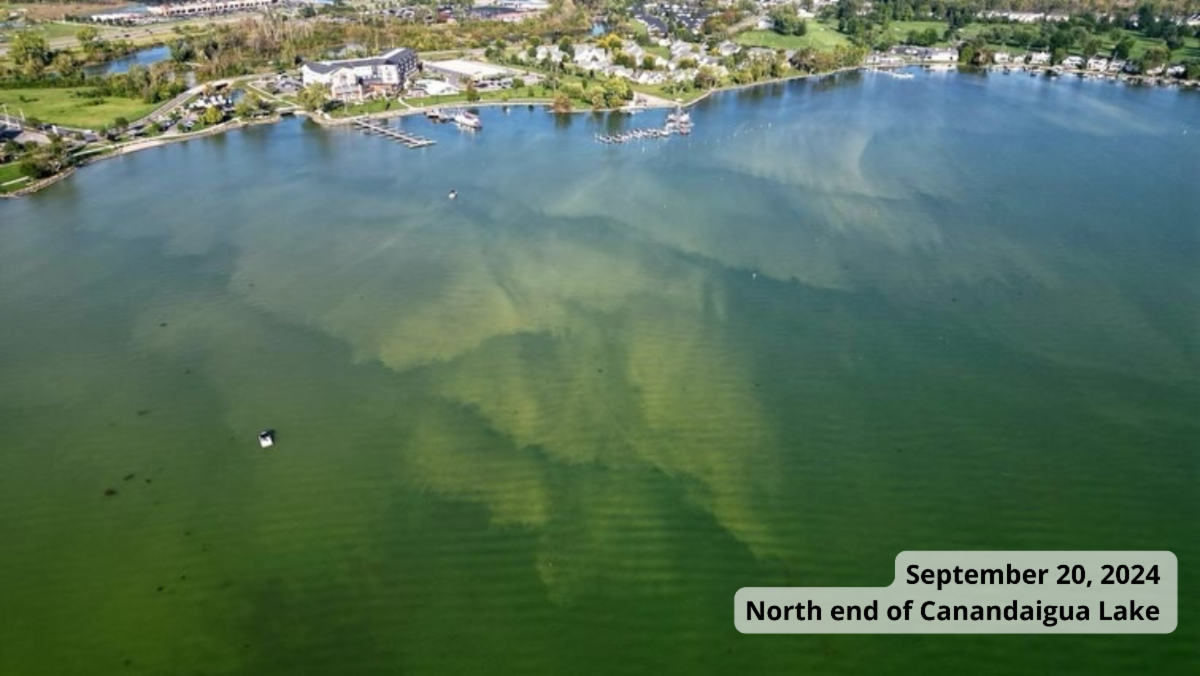
If you’ve been near Canandaigua Lake the last few days, you may have noticed a significant presence of CyanoHABs (Harmful Algal Blooms). We are currently in the midst of major bloom season, with 38 reports from our trained volunteers since Wednesday, 9/11. As of 12:15 PM today, we’ve already received 4 additional reports, indicating blooms along the shorelines along Kershaw Park and in the northeast.
It’s important to note that most of these reports have been contained to the northern half of the lake at this point. However, conditions may change quickly.
Key Reminders During Active Bloom Events:
• Look before you leap: Always check the lake’s condition before swimming or allowing pets to enter. Familiarize yourself with what harmful algal blooms look like and avoid them! Conditions can change rapidly, so even the latest maps may not fully capture current conditions.
• Signage may not reflect current lake conditions: With the Labor Day holiday behind us, many bathing beaches are no longer staffed with lifeguards and may not be routinely monitored. Warning signs for CyanoHABs may not be in place, so please remain vigilant before swimming.
• Drinking water monitoring: Canandaigua Lake water purveyors are collaborating with the Geneva District Office of the Health Department and the New York State Department of Health to monitor public drinking water for toxins associated with harmful algal blooms. During the bloom season, water samples are collected and sent to a State-approved laboratory to determine if any toxins are present. To date, no toxins have been detected in the finished drinking water. For more information on CyanoHABs and drinking water, click here.


A huge thank you goes out to our dedicated volunteers who continue to help us track CyanoHABs and report water clarity readings. Their efforts feed directly into the interactive map on the CLWA website, providing real-time data for everyone to stay informed. We are grateful to our volunteers for submitting reports, collecting samples, and helping to educate neighbors and friends on this issue.
In recent weeks, several water samples have been sent for analysis at SUNY Environmental Science and Forestry and the Finger Lakes Institute. While we will share a comprehensive report at the end of the season, a table with the most recent results is included below.
Please remember: water quality conditions can change daily, if not hourly, so it’s important to train yourself on what to look for to stay safe during this bloom season. Please refer to all the resources found at the bottom of this email to educate yourself fully.
CYANOHAB RESULTS FROM THIS WEEK
A subset of CLWA volunteers are trained to not only identify, but sample cyanoHABs. CLWA works with two different labs to analyze CyanoChl concentration (measurement of the blue-green chlorophyll) and microcystin (toxin) levels. The two labs we use are the Finger Lakes Institute in Geneva and SUNY ESF in Syracuse.
This week’s results (found below) are from the Finger Lakes Institute. The toxin results are forthcoming.

The NYSDEC considers a sample with concentrations of 25ug/L or greater of cyanoCHL to be a CyanoHAB. This means that all of this week’s samples were well above bloom thresholds, even the open water sample collected.
More information on cyanobacteria and the microcystin toxin:
• The most commonly found cyanobacteria in Canandaigua Lake (microcystis), read: As We Drink and Breathe: Adverse Health Effects of Microcystins and Other Harmful Algal Bloom Toxins in the Liver, Gut, Lungs and Beyond
• For info on cHABS in humans: Health Effects Support Document for the Cyanobacterial Toxin Microcystins

Water Quality Update for September 6, 2024
As summer winds down, our water quality monitoring efforts remain in full swing. This past week, volunteers remained vigilant and completed 75 surveys for cyanoHABs. Unfortunately, blooms persisted this week, with several reports coming in on Tuesday the 3rd and Wednesday the 4th. The calm, windless days and sunny weather provided ideal conditions for blooms, primarily reported along shoreline areas and in coves.

Last week, we shared test results from several of the bloom samples collected by trained volunteers and watershed staff during the peak of the bloom activity at the end of August. Results showed high microcystin toxin levels in several of the blooms. It is important to note that areas with visual evidence of cyanoHABs – green, discolored water, surface streaking, or a spilled paint appearance – must continue to be avoided as they may contain toxins that may impact pet and human health.
Additional Monitoring
CLWA / ESF Partnership
In addition to our regular cyanoHABs monitoring program, CLWA is participating in a 3-year research project in collaboration with SUNY Environmental Science and Forestry (ESF). Every Tuesday at 11 a.m., six sites on Canandaigua Lake (three on the east side, three on the west) are sampled from the end of docks. These routine samples—taken bloom or no bloom—are analyzed weekly for chlorophyll, toxin levels, and nutrients. Since sampling occurs at the same time each week and isn’t tied to bloom activity, most are collected under non-bloom conditions. This provides valuable baseline data on ‘ambient’ lake conditions during the summer. So far, results show that non-bloom areas consistently have minimal to low levels of cyanobacteria and the associated toxins, and are therefore well below a concentration that would close a public beach.
Canandaigua Watershed Council Fluroprobe Monitoring
Watershed Council staff have utilized the bbe Fluoroprobe on Thursday 9/5 to measure the major classes of algae/cyanobacteria throughout the water column (down to 100 feet below the lake surface) in three different locations on the lake. Results showcased that cyanobacteria concentrations ranged from zero to 2.5 ug/L in these locations. Cyanobacteria were highest near the lake surface down to 25 feet. As the probe reached 60 feet, cyanobacteria were undetectable. Additional sampling with the fluoroprobe will continue to occur through mid October.
We mention these other methods of monitoring because it is important to remember DEC guidance “If you see it, avoid it”needs to be followed. Non-bloom areas are often deemed safe for recreational use, but active bloom areas can arise quickly and should be avoided due to the likelihood that they may contain concerning levels of the microcystin toxin. It’s important to familiarize yourself with cyanoHABs and know what to look for to stay safe. Please refer to all the resources found at the bottom of this email to educate yourself fully.
Please check out the article for more information on HABs in the Finger Lakes and the challenges we face as a region in mitigating this concern.
Buoys out for DEC Gill Netting
During the week of September 9th, you may notice orange buoys with flags on Canandaigua Lake. These buoys mark areas where DEC Aquatic Biologists will be monitoring forage fish populations, primarily alewife. The nets will be set in depths ranging from 40 to 60 feet and, in some cases, may be relatively close to shore.
Thank you for your attention as the DEC carries out this important work.
Important update: Changes to Canandaigua State Marine Park Boat Launch after Labor Day
Parking at Canandaigua Lake State Marine Park will be unavailable after September 2nd, 2024, due to paving work on the parking lot. Please note that the launch area will remain open. Once the improvements are complete, parking is expected to reopen by late September or early October. Questions can be forwarded to the NYS Parks Office at 315-789-2331.
|
|
|
|
|
|
|
|
|
|

“The winds we’ve been experiencing have been great for sailing but less favorable for cyanoHABs formation, which has helped keep bloom activity in check over the past week. We had two localized blooms reported, with one confirmed by the NYS DEC. The confirmed bloom was observed last Friday, August 16, along Kershaw Park. It was an area of duckweed and watermeal, with some evidence of a bloom mixed in.
With cooler temperatures, our average surface water temperatures have also decreased. Last week’s average was 76.5°F, while this week’s average is 73°F. If you’re interested in how our surface water temperatures compared to last year, check out the graph below.

Although we’ve had some cooler, fall-like days, warmer temperatures are on the way. Remember, conditions can change daily, if not hourly, so it’s important to familiarize yourself with cyanoHABs and know what to look for. Feel free to reach out with any questions at HABS@canandaigualakeassoc.org.”


As the effects of last week’s tropical storm Debby subside, our watershed community continues to observe lingering impacts. The storm brought localized flooding, with rainfall amounts ranging from 3 to 5.5 inches in some areas within just a few short hours. With this runoff comes nutrients and sediments, and we are experiencing lower Secchi disk readings as a result of the increased turbidity. There has been a full-meter decrease in the weekly average Secchi disk reading since last week.
The intense rain also brought duckweed/watermeal that has been pushed out of the West River. I’m sure many of you have observed it! These tiny aquatic plants have been slowly making their way north with the lake currents. We have had reports of large swaths out mid-lake and the winds can also blow them into coves where they can collect. These can easily be mistaken for cyanoHABs because of their bright green color.
While duckweed and watermeal are naturally occurring and are harmless on their own, cyanHABs can get mixed in. Look for green, murky water or surface streaks alongside the duckweed.
We did have 8 suspicious cyanoHABs reports come in from volunteers this week, although several of them appear to be duckweeds. There are a few reports of surface streaking in the mix as well, so please continue to exercise caution when recreating in the lake and letting pets swim.
Remember, conditions can change daily, if not hourly, so your best course of action is getting familiar with cyanoHABs to know what to look for.
Feel free to reach out with any questions at HABS@canandaigualakeassoc.org.
 microbes such as E.coli.





