
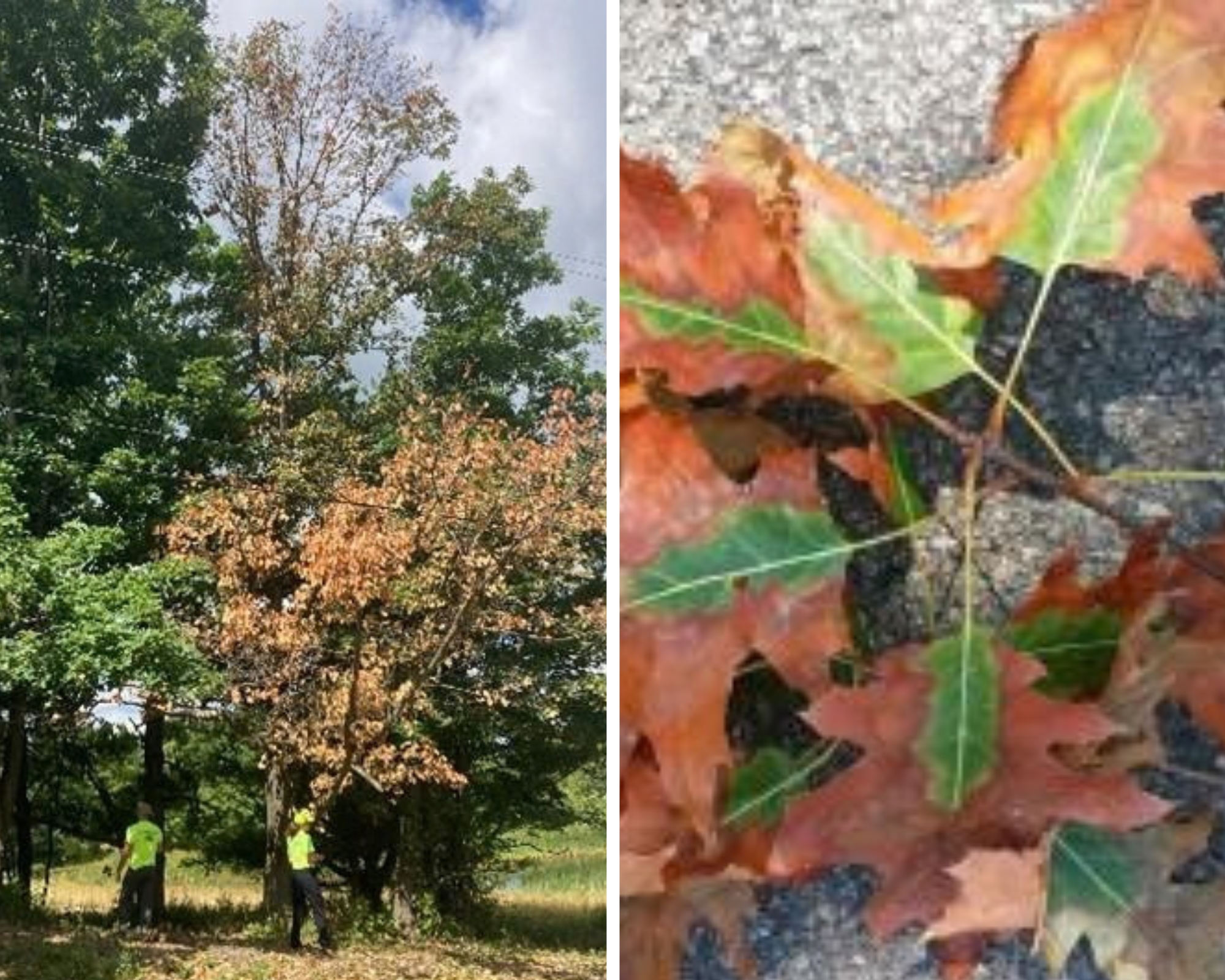
This past summer, oak wilt appeared on our property for the first time. Oak wilt is a serious fungal disease which most likely originated in Central or South America. The first case in NY was discovered in 2008 but through the efforts of the NY DEC, infections have thankfully remained isolated.
Oak trees are enormously important. Apart from their economic value, they play a critical role in our ecosystems. In fact, the oak is considered a keystone species. In a roman arch, the keystone is the wedge-shaped stone at the top which locks all the other stones into place. If you remove the keystone, the arch will tumble. Similarly, because oaks are at the base of the food chain, without oaks, the food web could be in danger.
We have about 16 native species of oaks in NY, divided into two categories: red oaks (including red, scarlet, pin, and black) and white (including white, burr, chestnut and swamp). Combined, they host about 385 species of insects. Their acorns are an important source of food, not just for squirrels, but for numerous small mammals, bears, and birds including jays and turkeys. Even wood ducks and mallards depend on acorns during the winter! Besides being a food source, oaks are important for shelter, breeding, and have massive root systems which hold onto soil and filter water. In addition, due to their size, mature oaks sequester more carbon than many other trees.
The lifespan of an oak in the state of NY, is 100-400 years, depending upon the species. And with each year, they have more cracks and crevices, offering habitat. Therefore, the longer an oak lives and the larger it grows, the more life it supports, the more carbon it sequesters, and the more water it filters.
Unfortunately, oaks, like many other species, are facing multiple threats. We have an overabundance of deer, who eat the saplings. We mitigate fires, so that within forests, shade loving trees have the advantage. Invasive plants are also crowding out oak saplings. Longer droughts due to climate change cause stress. Remember spongy moth caterpillars? They stressed our local oaks through defoliation for a couple of summers in a row and they’ll eventually be back. As if that isn’t enough, we now have oak wilt.
Oak wilt is a disease caused by a fungus called Bretziella fagacearum that cuts off the flow of water and nutrients from the roots to the crown of the tree causing the leaves to wilt, hence the name, eventually killing the tree. Red oaks are more susceptible and may die within a few weeks. White oaks typically last longer, a few branches dying at a time; sometimes they manage to survive. The fungus spreads in a few different ways:
- Native beetles. The fungus forms spore mats under red oak bark the spring after the tree has died. Nitidulidae, sap feeding beetles, and Scolytinae, bark feeding beetles both inadvertently pick up fungus spores while crawling around. When an oak branch is pruned or broken, it leaves a beetle-attracting wound thereby transmitting the disease to an otherwise healthy tree.
- Tree roots and inosculation. Neighboring oaks of the same group (red vs white) graft their roots together enabling the sharing of water and nutrients which is particularly helpful for weaker trees. However, this unfortunately also permits the fungus to spread underground from oak to oak.
- People. Pruning oaks during the growing season of NY (March – September/October) creates an open wound that attracts the insects. Moving infected firewood can transport both the fungus, and the beetles that spread it.
When the fungus infects a red oak, the symptoms are dramatic, as was the case on our property. In mid-July, our previously healthy black oak suddenly lost a massive number of leaves. Looking up into the tree, we saw the dying canopy. The leaves on the ground consisted of both dead leaves and leaves that were still partially green, but turning brown on an outer edge moving toward the central vein. My husband and I were immediately concerned and turned to the NY DEC website, where a list of symptoms confirmed our fears. I reached out to the DEC with pictures of the tree, the canopy, the trunk, a close-up of a leaf, and the number of leaves on the ground. They responded quickly and sent a couple of knowledgeable employees out for an inspection and samples. Within a couple of weeks, we had our answer. It was oak wilt, and the tree needed to be destroyed.
Once diagnosed, the DEC came back to assess how best to handle the situation. They scouted for any other trees in the red oak group within a 50-foot radius. Luckily for us, only one other small red oak was within that boundary. Then, they came back, cut down and chipped the two trees leaving only small fragments which cannot retain enough moisture for the fungus to survive. The stumps were also treated with an herbicide to kill the root systems. Happily, they were able to leave a white oak sapling growing nearby because the root systems of the two oak groups will not graft together.
Importantly, there was no cost to us for the consultation, diagnosis, cutting, or chipping of the tree.
The best way forward is to remain very vigilant. While the NY DEC does its part by conducting aerial surveys during the growing season, establishing quarantine areas that prohibit moving potentially diseased oak wood, and managing infected trees that they find, they can use our help.
- Go to https://dec.ny.gov/nature/forests-trees/forest-health/oak-wilt and learn the symptoms of infected trees.
- Help scout and report anything suspicious that you see.
- From March – October, don’t prune oak trees unless you must, apply a water-based spray paint or wound dressing to any wounds or pruning cuts, or consider hiring a tree professional.
- Follow NYS firewood regulations and rules within quarantine districts.
- Don’t be afraid to plant oak trees outside of a 150-foot boundary of any infected sites. Nature moves forward by natural selection of the healthiest specimens which cannot happen without enough oaks. We need more oaks adapting to oak wilt and other stressors, not less.
- Spread your new knowledge! I find that many people have never heard of oak wilt before.
If you would like to learn more about the amazing amount of life that oaks support, their importance in our ecosystems, and how to help them, click this link to watch the recorded public video by Douglas Tallamy, a renowned entomologist.
Why We Need Oaks and How to Save Them by Douglas Tallamy
References
New York State Department of Environmental Conservation. (2026, February 15). Oak wilt. https://dec.ny.gov/nature/forests-trees/forest-health/oak-wilt
Ducks Unlimited. (2020). Understanding waterfowl: Acorns and aquatic invertebrates. Ducks Unlimited Conservation. ducks.org
Tallamy, D. (2026, January 16). Why we need oaks, and how to save them [Video]. YouTube. https://www.youtube.com/watch?v=3ftjhtltV10
Photos by DEC