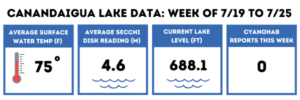
Friday, July 25th Water Quality Report

The Lake This Week

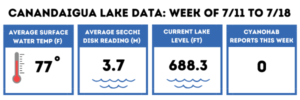
The week started off with several days that were mild and less humid, then temperatures climbed sharply mid-week into the 90s – and then cooled off again a bit at the end the week with some afternoon showers on Friday.

Lake clarity is improved very noticeably from last week – with the water appearing much clearer and not so green. Both the casual observer can notice the improvement and our secchi disk data collected by our volunteers averaged almost a full meter of increased depth.

While our neighbor Seneca Lake has now been added to the growing list of lakes having confirmed HABs this year – our lake still has not had any confirmed reports. Keep reading below to learn about some ‘HABs look-alikes’ that are out and about right now though. All in all – It was a gorgeous week to be out enjoying the lake!

Make a Splash for Canandaigua Lake at Wegmans

In collaboration with the Canandaigua Lake Watershed Council (CLWC) and the Canandaigua Lake Watershed Association (CLWA) – Wegmans is on a mission to raise awareness and funds for local projects and programs that protect and restore the watershed. Learn more about this collaboration here.

When you shop, you can:

  • Purchase a Make a Splash reusable bag
  • Donate at the register to support the health of Canandaigua Lake
  • Learn how you can get involved: become a member, volunteer, or make a donation

The campaign runs through September 10th.

Every bag, every dollar, every action makes a difference.

And we couldn’t do it without the incredible support of Wegmans — thank you!
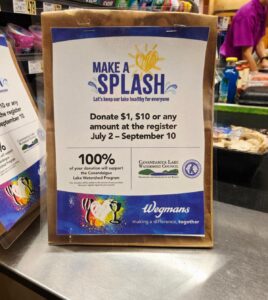


Have you been to Wegmans yet? Be sure to donate or round up at the checkout – and grab yourself a Make a Splash reusable bag!

New Lakefront Park and Culinary & Craft Beverage Hub Proposed

Plans are underway to turn a vacant 4-acre lot on the north end of Canandaigua Lake into a regional center for culinary arts and craft beverages. The project also includes a new proposed ‘Canandaigua Lakefront Arts & Natural Park’.

The site—previously considered for an expansion of Pinnacle North—may now host programs run by Finger Lakes Community College, New York Kitchen, and Cornell Cooperative Extension. The Canandaigua Area Development Corp. has offered to donate the land, pending project approval.

Read more here from Democrat and Chronicle article on July 7.

Let’s Work Together to Shape the Proposed Canandaigua Lakefront Arts & Natural Park

The City of Canandaigua is requesting community feedback for plans for the new property that will integrate with Kershaw Park. There is a survey available until Sunday July 27th at 6 pm. You do not have to be a resident of the City to participate. If you would like to share your thoughts about the new park complete the survey below.

Click here to complete the brief online survey.

cHABs Look-a-Likes

From a distance – large amounts of tiny plants floating on the water’s surface can be confused for HABs. But if you take a closer look – you will see that this is in fact a tiny plant called watermeal.

Winds on 7/24 likely pushed this watermeal out of the West River and you might see streaking mid-lake or accumulating onto shore (in this case, along with foam).

Watermeal is a natural, aquatic micro plant that shouldn’t be confused with a harmful algal bloom. The dense surface layers or ‘scums’ it can form along with its bright green color can make it easy to confuse for a HAB from a distance. But if you look up close – it looks ‘seedy’ or ‘gritty’ in appearance.
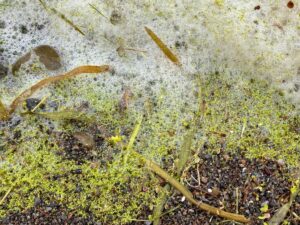
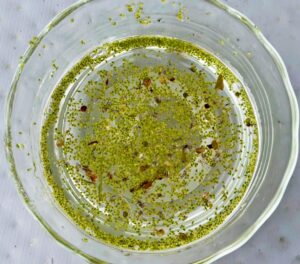
left: watermeal and foam washing up along the lakeshore. Right: close up of watermeal – with some some duckweed mixed in too. photos courtesy CLWA volunteer Lynn Klotz

New Finger Lakes Foam Reporting Tool Launched
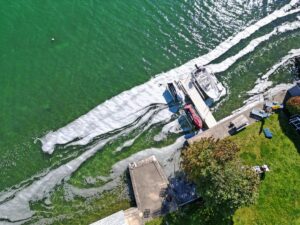
Foam on Canandaigua Lake on October 3, 2024. photo courtesy Emily DeBolt

We are excited to announce the launch of a new Finger Lakes wide foam reporting survey. After working on Canandaigua Lake, Rick and Stella from GAR have expanded their research to include other lakes. We helped them adapt the Canandaigua Foam reporting tool into a larger region-wide survey. If you have participated in the foam survey in the past, you will now need to use this new foam survey. If you have the old one loaded into the Survey 123 app you will want to delete that one and download this one.

You can learn more all about the foam found on Canandaigua Lake and find the link to the survey on our Foam page on the website: https://www.canandaigualakeassoc.org/water-quality/lake-foam/

Read an update about GAR’s work in our most recent Summer Newsletter here.

Stay informed so you can enjoy Canandaigua – or other New York Lakes – safely and confidently this summer.

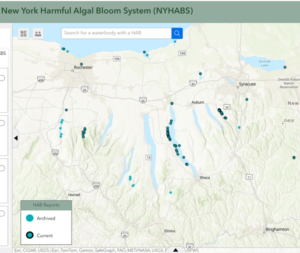
One tool for doing just that is the online NYHABs map. Once we start having blooms reported on our lake – we also have our own map that is available on our website as well.

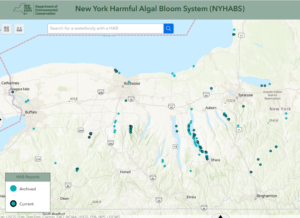
NYHABS Map

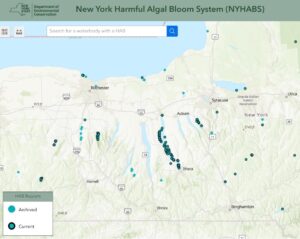
The link below leads to the NYHABS interactive map and displays the location of HABs in New York State. Each blue dot outlined in black represents a HAB reported in the past 2 weeks. There may be other waterbodies with cHABs that have not been reported to DEC. All reports through our monitoring program are shown on our own map on our website. CLWA staff uploads all cHABs report to the NYHABs database that we receive through our trained volunteers.

This past week neighboring Seneca Lake had their first blooms of the season on July 22, adding them to the list of lakes that have confirmed HABs so far this year.

Visit NYHABS map here
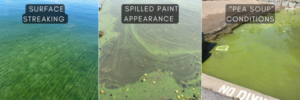
Remember – conditions can change rapidly. Please use caution when out on the lake and look for characteristics of CyanoHABs including water that looks like:

  • Pea soup, spilled paint, surface streaks or scum
  • Color’s that are typically green, blue-green or yellow but can also be brown, red or purple
  • Typically found along shorelines or coves

For images and more information on CyanoHABs, refer to the section below.

The official volunteer CyanoHABs monitoring program begins today and runs through October 2nd, 2025 but we have encouraged our volunteers to still keep an eye out on conditions prior to this date and report if they suspect bloom-like conditions.

Please, to keep yourselves and pets safe, avoid any water conditions that appear to be bloom-like. Don’t hesitate to reach out to us at 585-394-5030 with any questions or email us at HABS@canandaigualakeassoc.org if you are concerned about water quality. Sending us photos of the water is strongly encouraged. Have a wonderful weekend and stay tuned.

Posted in News, Water Quality Updates

Water Quality Update 7/18/25


Current Lake Conditions

This week was hot until a very windy Thursday blew in some cooler air to end the week. The lake has heated up and turned a light green. Secchi disc readings fell below 4 meters (about 13 feet) indicating decreased water clarity from last week. Water temperature at beaches and docks have gotten over 80 degrees.

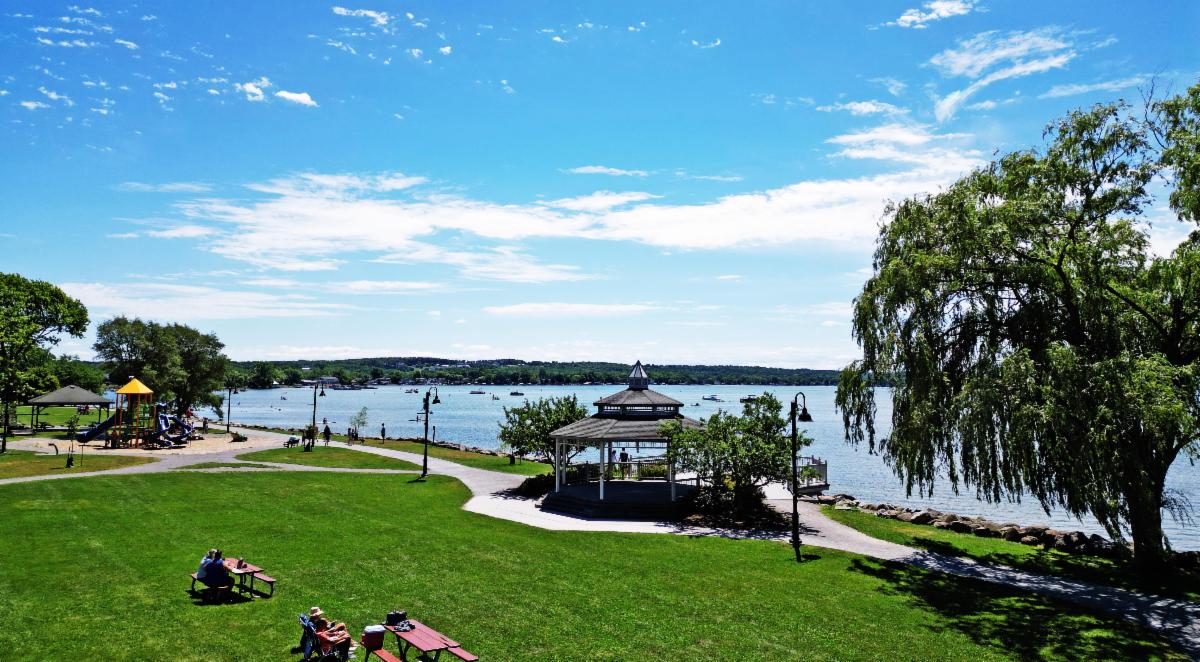
Friday (today!) was a gorgeous day down at the lake. Lots of people enjoying the blue skies and slightly cooler – but still plenty warm – weather.


Lake Temp

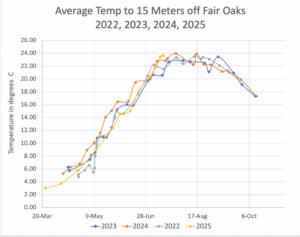
CLWA’s temperature at depth project shows that average temperature to 15 meters (about 50 feet) has increased, making up for a cool May and at this stage 2025 is slightly warmer than the last few years.


It Takes a Village

There are many people involved in monitoring the lake to help inform our community and collecting data to support management decisions and actions.

Our CLWA volunteers are:

  • monitoring shorelines all around the lake and keeping an eye out for any bloom conditions.
  • measuring chlorophyll and phycocyanin in the lake with our new YSI probe – two parameters to determine how much cyanobacteria is in the water.
  • using ioLight microscopes to look at water samples and see when microsystis – a common cyanobacteria in our lake – is present.

Staff from the Watershed Council (CLWC) and FLCC are collecting important data all summer as well as part of their long term monitoring program. They are also doing plankton tows and taking fluoroprobe measurements to confirm the composition of the phytoplankton in the water. It’s all hands on deck with many organizations all working together to protect the lake!

What’s in the water right now?

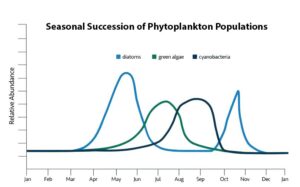
Recent fluoroprobe results from CLWC and FLCC show that green algae and diatoms are currently dominating the water column, which explains the green color many people have noticed. These algae are common in lakes and do not produce toxins or harmful algal blooms (cHABs).

Our CLWA volunteers have also been monitoring for pigments linked to cyanobacteria—the organism responsible for HABs—using our YSI probe. So far, levels remain low, confirming that green algae and diatoms are the main players right now.


Diatoms typically dominate early in the season, followed by green algae, and then cyanobacteria, and then the diatoms come back at the end of the season again. This is a generalized graphic of relative algal abundance over time for a typical low to medium productive lake such as Canandaigua. As you can see – we would expect to see green algae and diatoms right about now.

Collecting Data: How a fluoroprobe works

Fluoroprobes are used in the field to measure chlorophyll and blue-green algae in water by detecting their fluorescence. These sensors shine a specific wavelength of light—usually from an LED or laser—onto the sample.

The light excites molecules (called fluorophores) and the electrons in the fluorophores move to a higher energy state. As the electrons return to ground state, they release excess energy as fluorescence, which a photodetector in the sensor measures.


Why Wavelengths Matter in Algae Detection

Fluorometers measure substances based on their unique light “signature.” Each has specific excitation and emission wavelengths: a high-energy, short-wavelength light excites the substance, and a lower-energy, longer-wavelength light is emitted as fluorescence.

For chlorophyll-a—the most common form of chlorophyll—fluorometers typically use blue light (~470 nm) for excitation. The chlorophyll then emits red light in the 650–700 nm range, which the sensor detects to measure algae levels. This is the science we all learned the basics of in middle school – and makes for a great jeopardy question for sure! (image and content sourced from Nexsens Technology – Click here to learn even more about measuring chlorophyll and cyanobacteria)

Stay informed so you can enjoy Canandaigua – or other New York Lakes – safely and confidently this summer. One tool for doing just that is the online NYHABs map. Once we start having blooms reported on our lake – we also have our own map that is available on our website as well.

NYHABS Map

The link below leads to the NYHABS interactive map and displays the location of HABs in New York State. Each blue dot outlined in black represents a HAB reported in the past 2 weeks. There may be other waterbodies with cHABs that have not been reported to DEC. All reports through our monitoring program are shown on our own map on our website. CLWA staff uploads all cHABs report to the NYHABs database that we receive through our trained volunteers.

Visit NYHABS map here


Remember – conditions can change rapidly. Please use caution when out on the lake and look for characteristics of CyanoHABs including water that looks like:

  • Pea soup, spilled paint, surface streaks or scum
  • Color’s that are typically green, blue-green or yellow but can also be brown, red or purple
  • Typically found along shorelines or coves

For images and more information on CyanoHABs, refer to the section below.

The official volunteer CyanoHABs monitoring program will begin on July 25th and run through October 2nd, 2025 but we have encouraged our volunteers to still keep an eye out on conditions prior to this date and report if they suspect bloom-like conditions.

Please, to keep yourselves and pets safe, avoid any water conditions that appear to be bloom-like. Don’t hesitate to reach out to us at 585-394-5030 with any questions or email us at HABS@canandaigualakeassoc.org if you are concerned about water quality. Sending us photos of the water is strongly encouraged. Have a wonderful weekend and stay tuned.
Posted in News, Water Quality Updates

Water Quality Update for Friday, July 11th 2025

We hope everyone had a great Fourth of July last Friday. This the first of our weekly Friday water quality report for the 2025 season. If at anytime water quality issues arise during the week, we will send out email notifications and reports on our social media platforms as well. Please encourage family and friends that also recreate on the lake, to sign-up for our email notifications so that they can stay informed on lake conditions as well. They can do so on the homepage of our website where you can also find our interactive map of bloom reports.

This week we have been notified by a few of our water quality monitoring volunteers that they have noticed changes in the color of the water and possible pre bloom-like conditions. CLWA and CLWC staff visited a few sites along the northwest side of the lake on Thursday afternoon but no visible blooms were found. Secchi disk readings dropped lower this week than normal. Last year at this time our average secchi reading was 5.9 meters – and this year it has dropped to 4.6 m already. We didn’t have an average reading that low until mid August in 2024. It isn’t always clear what causes these changes from one year to the next. But the recent heavy rains washing sediments and nutrients into the lake are likely a contributing factor.

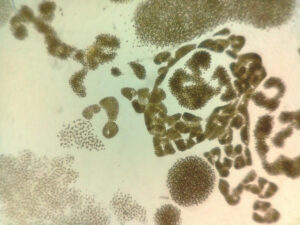
CLWA volunteers with iolight microscopes have been looking at water samples and this is the first week they have found some Microsystis in them. CLWC staff also did 3 plankton tows with FLCC and found a diversity of zooplankton along with some minor concentrations of Microcystis in those samples this week as well. So while we haven’t had a bloom yet – unfortunately it looks like they will likely be arriving sooner rather than later. Some of our neighboring lakes have already had blooms this year. Conesus Lake, Waneta and Lamoka, Honeoye, Otisco, and now Cayuga Lake has had numerous widespread HABs reported this week.


photo from CLWA Volunteer Sally Napolitano showing Microsystis cyanobacteria


Visit NYHABS map here


Remember – conditions can change rapidly. Please use caution when out on the lake and look for characteristics of CyanoHABs including water that looks like:

  • Pea soup, spilled paint, surface streaks or scum
  • Color’s that are typically green, blue-green or yellow but can also be brown, red or purple
  • Typically found along shorelines or coves

The official volunteer CyanoHABs monitoring program will begin on July 25th and run through October 2nd, 2025 but we have encouraged our volunteers to still keep an eye out on conditions prior to this date and report if they suspect bloom-like conditions.

Please, to keep yourselves and pets safe, avoid any water conditions that appear to be bloom-like. Don’t hesitate to reach out to us at 585-394-5030 with any questions or email us at HABS@canandaigualakeassoc.org if you are concerned about water quality. Sending us photos of the water is strongly encouraged. Have a wonderful weekend and stay tuned.
About CyanoHABs

Cyanobacteria, sometimes referred to as blue-green algae because of their color, are among the oldest organisms on Earth. They are naturally occurring in our lakes, generally in low numbers.

When triggered by the perfect storm of conditions – such as heavy rains followed by a few days of warm weather with calm winds – cyanobacteria may begin to increase, forming “blooms”. CyanoHABs can appear quickly and persist for hours or days, or they can disappear almost as quickly as they formed.

Since previous research informs us that high levels of toxins (microcystin) may accompany the blooms, humans and our pets should avoid coming into contact with the water when an active bloom is observed.

How to identify blooms

Use visual cues to identify potential blooms. They can appear like pea soup, spilled paint, surface streaks or scum. The color is typically green, blue-green, or yellow, but can also be brown, red, or purple. When blooms are discovered, they are usually found along shorelines or in cove areas. They are most often seen along the stretch of shoreline that is impacted by the prevailing winds. However, during significant bloom events, sometimes they can be found in open water areas.

Visit the NYS DEC website to learn more about identifying blooms.


What should you do if you suspect a bloom

When in doubt, stay out!

  • Don’t swim, wade, jetski, waterski or tube in a bloom.
  • Shower if exposed to bloom conditions. Wash pets off if they have gone into bloom-infested waters.
  • Don’t consume fish from the lake during blooms.
  • Do not use PRIVATE water drawn from the lake during a bloom. Public water supplies have safeguards in place and can be utilized unless you are otherwise notified.

Report the bloom to the NYSDEC NYHABs portal: on.ny.gov/habform

CyanoHABs Links and Resources

Further reading on cHABs and their impacts on human and pet health

NYS Department of Health HABs Website

NYS Department of Environmental Conservation HABs Website

Dogs and HABs

Drinking Water and HABs

Information for Surface Water Drawers during HAB Season

Article on the Contributing Factors to HABs in Canandaigua Lake

If you have any questions please don’t hesitate to reach out to HABs@canandaigualakeassoc.org

Posted in News, Water Quality Updates

Keeping Roads Safe And Protecting Water Quality: A Sustainable Winter Road Salt Program In Canandaigua

This article is from the Canandaigua Lake Watershed Council, our intermunicipal organization consisting of the chief elected officials of the 14 watershed and water purveying municipalities, working together to maintain and enhance the high water quality of the Canandaigua Lake watershed.

After two years of mild winters, we certainly saw our fair share of snow and ice this season. While we all appreciate the winter wonderland, the challenges of keeping our roads safe can have impacts on the environment, particularly when it comes to road salt. But there’s good news – the Town of Canandaigua highway department, under the leadership Highway Superintendent Jim Fletcher, have been taking action to protect both road safety and the health of Canandaigua Lake.

The Canandaigua Lake Watershed Council (CLWC) identified road salt reduction as a strategy for protecting the long-term health of the lake and secured funding through a New York State grant to implement a Sustainable Winter Road Maintenance Program. This pilot program directly addresses rising chloride levels in Canandaigua Lake, which have doubled since the 1990s, according to research by retired Finger Lakes Community College professor Dr. Bruce Gilman. This increase is largely attributed to road deicing operations, with road salt persisting in the watershed for long periods. Over time, this can harm water quality and disrupt aquatic life, making salt reduction an important tool for lake protection. 

Three local municipalities—the City of Canandaigua, Town of Canandaigua, and Town of Gorham—are leading the way in the Sustainable Winter Roads pilot program. The initiative aims to enhance road safety during winter weather while minimizing impacts on water quality. Highway superintendents and the watershed team worked in coordination with experts at the Cornell Local Roads Program and also researched nationwide programs – including the Minnesota Snow and Ice Control Program – to develop a pilot program tailored to the Canandaigua Lake watershed.

Enhancing Technology to Keep our Roads Safe
Maintaining our roads during winter isn’t as simple as just hopping into a truck and hitting the road. Our highway crews are using advanced technologies to precisely track the amount of salt applied, adjusting for changing weather conditions. These tools help ensure roads stay safe without over-salting, benefiting both residents and the environment.

The Sustainable Winter Roads Maintenance Pilot Program has allowed the Town of Canandaigua’s plow trucks to be equipped with the following new technologies:  

-React Blades: Segmented blades that adapt to changing road surfaces, scraping snow and ice closer to the pavement than traditional plow blades, which helps reduce the need for additional salt.

-Weather Stations, Video Cameras, and Road Temperature Sensors: Advanced monitoring systems that provide real-time insights into road conditions, enabling more accurate        decision-making for salt application.

-Software and Calibration Systems: Tools that allow operators to track key data such as road conditions, temperature, and salting patterns. The software helps monitor salt                usage, ensuring precise applications and reducing environmental impact.

These tools allow municipalities to adjust their strategies for varying weather conditions, ensuring that roads are kept safe without over-applying salt.

Road Salt Reductions in Real Time
Thanks to the new technologies, the impact of the pilot program can be tracked and quantified. Early results show that the Town of Canandaigua has reduced its salt usage from 450 lbs. per lane mile to just 325 lbs! The Town of Gorham has achieved a similar reduction, from 600 lbs. to 350 lbs. These reductions not only improve watershed health but also lower municipal costs due to more efficient salt application.

More to Come
Additional technologies and methods are being considered for the future, including a pre-wetting system that reduces scatter on the roads, ensuring salt stays where it’s needed. Pre wetting also allows snow and ice to melt more quickly, reducing the need for further salt applications.

The Canandaigua Lake Watershed Council extends our thanks to Jim Fletcher and our dedicated Highway Department staff for their commitment to keeping our roads safe while taking proactive steps to protect the health of Canandaigua Lake.)

Posted in News

Special Contribution: Exploring Watershed Hiking Trails

Watershed Hiking Trails by Doug Llewellyn 

This is the third in a series of Outreach and Education Committee articles that focuses on Lake-Friendly Living. Whereas the first two articles offered suggestions on ways to keep our watershed in a healthy state, this one takes a different slant and is predicated on a quote from E. B. White, author of Charlotte’s Web – “I arise in the morning torn between a desire to improve (or save) the world and a desire to enjoy (or savor) the world. This makes it hard to plan the day.”

So, let’s temporarily depart from the approaches to protect our watershed and turn to ways to enjoy our watershed – specifically getting out during the crisp, robust upcoming fall days and taking a hike on one of the many easy to moderate hiking trails within the Canandaigua Lake watershed – namely, Atwater Meadows, the Upland Trail at Onanda Park, the Vista, and Grimes Glen. 

Atwater Meadows is an 18-acre wooded, undeveloped park on the north end of Canandaigua Lake at 767 West Lake Drive, just south of Yacht Club Cove. At the end of the gently-sloped footpath there’s a small lake-front beach area that offers a picturesque view of Skenoh Island (previously named Squaw Island). According to legend, the wives and children of the Seneca took refuge on the small island during the invasion of their homeland by General John Sullivan in 1779.The renamed island “skenoh” can be translated to either health or peace. 

Dogs are welcome, but must be on a leash. 


Upland Trail at Onanda Park at 4965 West Lake Road is a 1½ to 2-mile loop trail generally considered a moderately challenging route. It takes an average of 45-60 minutes to complete the loop and is a popular trail for hiking, bird watching, and identifying local woodland plants. The Uplands consists of seventy-three acres of hillside including a path through pristine wilderness with scenic views of Barnes Creek, as well as Canandaigua Lake. Sturdy footwear and hiking poles may be needed for the less experienced hiker. Dogs are welcome, but must be on a leash.

Check out www.townofcanandaigua.org for more trail information and a site map.


Canandaigua Vista – Finger Lakes Land Trust Trail is located down Jones Road at the corner of Route 21 and Seneca Point Road, just south of Cheshire. The vista is 90 acres of mature forests and open meadows with expansive views of Barnes Gully and Canandaigua Lake. A visitors’ booth at the entrance of the park will show the vista’s trail and best viewing locations. Similar to Ononda Park, it takes an average of 45-60 minutes to complete the loop and is a popular trail for hiking, bird watching, and identifying native woodland plants. The trail is mostly flat.   

Be aware that during the hunting season, from October 1 to December 17, bow hunters will be hunting on the preserve in locations that are at least 150 feet from the marked hiking trail, and the trail will remain open to the public during that time. Hikers must stay on the marked hiking trail at all times. Hunters will be allowed to hunt with a bow only. For that reason, a hike through the Vista Park would be best during the spring and summer months. Check out www.fllt.org/canandaiguavista for more information.


Grimes Glen is located at the south end of the watershed in the Village of Naples. From Main Street/Route 21 (heading south), take a right turn at Vine Street. A sign shows the road entrance to the park. Take Vine Street to the end where a parking lot and the park entrance is located.

According to the NY Falls website, Grimes Glen is a 1½ mile trail where visitors can experience the sights and sounds of bubbling cascades, crystal clear pools, and spectacular waterfalls, all framed by majestic hemlock trees, bountiful springtime red and yellow trilliums, and various native wildflowers. Shale bluffs tower up to 200 feet overhead. Grimes Glen is a classic Finger Lakes gorge, a continuously changing and fragile environment shaped and reshaped over time by the power of water. For that reason, check the entrance booth to see which waterfall trails are safe and open to the public. For a stunning view, visit the park in the early spring when the winter’s snow begins to melt and fill the creek with strong currents. 

See https://nyfalls.com/waterfalls/grimes-glen/ for more information.


These are just four of the many woodland trails and waterfall parks located within our watershed. For a more rigorous venture, hikers may want to also check out Bare Hill and Conklin Gully (both on the southeast side of the lake), as well as High Tor Wildlife Management Area (at the south end of the watershed).  

Posted in Lake Friendly Living

Water Quality Update for October 28, 2024

Today, we received several reports of late-season cyanobacteria harmful algal blooms (cyanoHABs). This includes five reports from our dedicated volunteers and two additional reports from concerned members of the public. With these latest sightings, we have surpassed the latest recorded bloom date of October 26th (in 2023).

Volunteers participating in a research project with SUNY ESF have identified that the samples, viewed under a microscope, primarily consist of Dolichospermum, a genus of cyanobacteria known to produce various toxins. This finding highlights the critical importance of our ongoing monitoring and reporting efforts.

As always, we urge people and pets to exercise caution around the water, especially if it appears discolored or has a surface scum.

This has been a discouraging season, but we are deeply grateful to our dedicated volunteers for their commitment to monitoring and reporting. Interested in joining us next year? Complete the form, and we’ll be sure to reach out about next year’s training: https://forms.gle/C76gg3QznSWp3DuB7
Posted in Water Quality Updates

Water Quality Update for October 21, 2024

While the recent milder temperatures and beautiful fall weather have been a real treat, they’ve also brought a few more cyanoHAB reports. This afternoon, three of our dedicated volunteers reported surface streaking – two on the east side and one on the west side of Canandaigua Lake.

Please continue to keep an eye out for any signs of cyanobacterial harmful algal blooms.

As a reminder, cyanoHABs reports from across the state can be viewed by visiting the NYHABs portal on the DEC website: https://nysdec.maps.arcgis.com/…/webappvi…/index.html…


See insights and ads
Promote
All reactions:

Finger Lakes Premier Properties and 6 others

Posted in Water Quality Updates

Water Quality Update for Friday October 4, 2024

Lake conditions have generally been improving over the last week, with fewer reported blooms. The blooms that have been reported have been more localized. Today, we received a cyanoHAB report from Vine Valley and the volunteer from that region collected a sample for further analysis. All other reports submitted today have indicated no visible signs of blooms.

The official volunteer CyanoHABs monitoring program concluded yesterday, October 3rd, and this is our last official Friday Water Quality Update of the season. However, we still have many engaged volunteers who will continue to keep eyes on the lake and report conditions, so information can continue to be accessed via the interactive map on the CLWA website or our Facebook page.

In years past, we have seen blooms pop up well into October. In 2023, our last reported bloom was on October 26th! This reminds us that we need to remain vigilant – lake conditions can change quickly.

It’s important to remember that the cyanoHABs issue isn’t just unique to Canandaigua Lake. This has been one of the most intense cyanoHABs seasons on record for our Finger Lakes region, and other lakes around the county are also experiencing an uptick in blooms. Even Lake Superior—the deepest and coldest of the Great Lakes—has been affected by algal blooms for the first time in history, as highlighted in this recent article: Climate change is causing algal blooms in Lake Superior for the first time.

We want to thank you for staying engaged, spreading awareness, and supporting the many volunteers who contribute to these efforts. CLWA is stronger because of community involvement, and we need that support to continue beyond bloom season. Keeping the impacts of HABs at the forefront with state agencies, elected officials, municipalities, and all our lake stakeholders is vital for identifying and implementing long-term solutions.

As the bloom season winds down, we will be receiving more of our sample results and will be putting together a season-end report for the community. Stay tuned!

Posted in Water Quality Updates

Water Quality Update for Friday, September 27th 2024

IN THIS REPORT:

  • Recap of September Blooms
  • Using Remote Sensing to Monitor for cyanoHABs in Canandaigua Lake
  • CyanoHABs in the News
  • Information for Private Drinking Water System Users
As September comes to a close, it has certainly been a notable month for water quality. In last week’s report, we highlighted the severity of the harmful algal blooms (HABs) affecting Canandaigua Lake and other Finger Lakes. The image below, taken the afternoon of Friday 9/20 from the lake’s north end, shows just how extensive the blooms have been, even in open water areas.

Canandaigua Lake experienced an unprecedented 14 consecutive days of cyanoHABs, from September 10th through September 23rd—marking the longest documented stretch of bloom activity since cyanoHABs monitoring efforts began in 2015. Fortunately, cooler temperatures and a few rainy days have brought some relief this week, with only two small localized blooms reported on 9/26. However, some years we have seen blooms well into October, so we urge you to continue using visual indicators before entering the water or letting pets swim. Identification photos can be found at the bottom of this email to help you recognize potential cyanoHABs.

A special thanks to Emily DeBolt for capturing this image.

We’d like to take a moment to recognize the outstanding efforts of our 77 volunteers who have worked tirelessly this summer to document the lake’s water quality. Their commitment is vital to advancing our understanding of these evolving water issues. Thanks to their work on the cyanoHABs and Secchi disk programs, 630 reports have been submitted thus far. As the Association Director, I want to personally thank each and every one of our volunteers for their invaluable contribution. These reports not only inform our local community but also provide crucial information to the Department of Health, municipal partners, water purveyors, state and local agencies, and the broader research community. The Watershed Council, consisting of the municipalities and its Watershed Manager Kevin Olvany, are also incredibly appreciative of all the volunteer reports coming in. Citizen scientists are the heart of this community, and these efforts will leave a lasting impact on the ongoing research.

As we head into October, the official CyanoHABs monitoring program will conclude on October 3rd, with our final scheduled water quality update going out on Friday, October 4th. Please note that many of our dedicated volunteers will continue to monitor and report beyond this date. If significant bloom events occur in October, you can always check the interactive map on the CLWA website or our Facebook page for the latest information.

If you’re interested in learning more about our research partnerships, check out the video below featuring Dr. Bahram Salehi from SUNY ESF. Last Friday, we captured this footage as drones flew over the lake, collecting multispectral imagery to train AI models for remote water quality monitoring. This is another great example of how volunteer data is helping advancing the science of cyanoHABs

Thank you for your continued vigilance and support.

Lindsay McMillan, CLWA Association Director

Remote Sensing to Monitor for CyanoHABs on Canandaigua Lake

On Friday, September 20th, 2024, CLWA had the opportunity to connect with Dr. Bahram Salehi, Associate Professor of Remote Sensing Engineering at SUNY Environmental Science and Forestry (ESF), and PhD Candidate Sina Jarahizadeh as they performed research on Canandaigua Lake. Learn more about their work to monitor lakes experiencing harmful algal blooms using a combination of multispectral and satellite imaging in the short video below.


CyanoHABs in the News: The Growing Severity of Harmful Algal Blooms in the Finger Lakes
The intensity of the blooms in Canandaigua Lake and surrounding Finger Lakes was covered heavily in the local media this past week. Check out the following highlights, in case you missed them.

Health expert warns of record-setting harmful algal blooms in Canandaigua Lake (13 WHAM News)

Harmful algal blooms on the rise in local lakes this summer (FL Times)

CyanoHABs remain a concern for lakes across Western NY (WROC TV)

Harmful algal blooms spread across nearly every Finger Lake (Democrat and Chronicle)

Information for Private Drinking Water System Users

Until recently, living on Canandaigua Lake and drinking its water, it was considered sufficient for a private water system to filter sediment and particles and have a method to kill microbes such as E.coli.

Today, homeowners must go a step farther to remove toxins such as blue-green algae and plasticizer chemicals. This requires considering updated water purification for potential contaminants.

Read this special contribution by Dr. Bruce Capron to see how some homeowners are approaching updates to their private drinking water systems.

Read the article here.

Posted in Water Quality Updates

Keeping Canandaigua Lake Clean: The Role of Sanitary and Storm Sewers in Water Quality

Special contribution by Doug Llewellyn

This is the second in a series of informative articles by the CLWA Outreach and Education Committee, designed to offer practical approaches to Lake-Friendly Living.

As watershed residents, we all share the responsibility of protecting the health of Canandaigua Lake for generations to come. One important step is understanding the difference between sanitary and storm sewers. When leaves, lawn clippings, and road litter wash into storm drains, they can degrade water quality. By knowing how these systems work, we can make informed decisions about what shouldn’t enter our sewers, creating a less harmful impact on our watershed.

A sanitary sewer has a full cover (often termed a “man-hole cover”) secured flat to its circular rim at the surface of the road. The purpose of the sanitary sewer is to move wastewater from residential and commercial properties to a treatment facility. However, there are several things to know before flushing objects down the toilet. You should never flush baby or hand wipes (even the flushable ones) down a toilet. These wipes do not easily disintegrate. They cause clogged drains and pipes, resulting in backups and costly repairs to the Town’s Public Works System. 

Other non-dissolvable products that should not be flushed down the drain or toilet includes diapers, feminine hygiene products, any greasy or oily food wastes, cotton swabs and plastic products, medications, cigarette butts, hair, gum, coffee grounds, egg shells, or dental floss. 

The storm drains, on the other hand, have a grate cover that acts like a screen to block large items (such as twigs and small tree branches) from draining down the opening. Storm sewers handle runoff from heavy rains, melting snow, and water from surrounding streets and driveways. Storm sewers move water through a network of channels from its drainage site to a natural body of water – usually a stream, river, retention pond, or lake. Since much of the untreated water from the storm sewers ends up in our lake, residents should pay particular attention to reduce or prevent what gets washed into the storm sewer.

Here are just a few suggestions to help our watershed surroundings:

  • Leave grass clippings on the lawn. Do not blow clippings into the street or curb. Consider creating a compost bin for cut grass and yard wastes.
  • Rather than raking leaves into the road, use your lawn mower to mulch leaves during the fall months. 
  • Eliminate or reduce the use of inorganic lawn fertilizers especially those high in phosphorus.  
  • Pick up litter and pet waste that you see on your property before it gets washed down the storm drain.
  • If you self-wash your car, wash it on your lawn instead of the driveway. Washing your car in the driveway allows soapy water (containing phosphates) as well as dirt, grease, oil, and road salt to flow into the storm drain. 

Now that we know more about sanitary and storm sewers, let’s all work together to become mindful of ways to help safeguard our treasured watershed and keep it healthy for our children, our grandchildren, and generations to come.

Posted in Lake Friendly Living Tagged with: