

LED flares light up the night during the Canandaigua Lake Ring of Fire celebration on September 4, 2021. Photo credit: Gregory Wolfe, Aerial Photography of Rochester
Canandaigua Lakefront Residents Make a Difference with Wide Adoption of LED Flares for 2021 Ring of Fire
Wegmans Reports More Than 6,600 LED Flares Sold by Canandaigua Store.
Canandaigua Lake Watershed Association to Continue Promoting Lake-Friendly Alternative for 2022.
September 10, 2021 — Canandaigua, NY – Canandaigua Lake Watershed Association (CLWA) announced today a successful first-year transition from incendiary flares to more lake-friendly LED flares along the shores of Canandaigua Lake for the 2021 Ring of Fire held on September 4, 2021. Wegmans Canandaigua reported 6,654 LED flares were purchased prior to the Ring of Fire.
In 2017, CLWA stopped selling incendiary flares as a fundraiser to align with its mission to protect the lake’s water quality and shores from environmental hazards. In 2021, CLWA efforts went a step further with a special collaboration courtesy of Wegmans Food Markets. This included the Wegmans store in Canandaigua, along with eight other Wegmans at lake locations in the Finger Lakes and Western New York, no longer selling incendiary flares and now carrying LED flares.
“The Canandaigua Lake Watershed Association found an environmentally sensitive alternative without compromising tradition,” said CLWA President Lynn Klotz. “I’m thrilled to have seen such a great response from the lake-wide community demonstrating their care for the quality of the biggest resource here, Canandaigua Lake. We invite all lake-side residents to take the pledge to convert to LED flares in 2022.”
CLWA members worked with Wegmans Food Markets earlier in the year on identifying the model to sell to replace incendiary flares with an LED flare. Wegmans discontinued selling incendiary flares and now carries both two-packs and six-packs of the LEDs, donating $2.00 and $6.00 respectively, to CLWA and Honeoye Lake Association for flares purchased through September 25, 2021.
Awareness and success of the LED flare project were due in large part to the vision and leadership of CLWA member Greg Talomie. He was supported by many other CLWA members, including Charlie Constantino and Chuck Wochele. Kevin Olvany of the Canandaigua Watershed Council and council members also were instrumental in the effort.
The LED flare being sold by Wegmans is reusable, shines long into the night, has a flicker mode, and can be seen one mile across the lake–all without leaving a chemical residue. These units resemble traditional flares and average approximately 90 to 100 hours of run time on regular or rechargeable +AAA batteries. Although more expensive than the chemical flares, LED flares can save money over time because they are reusable from year to year and can be used in a vehicle or boat.
About Ring of Fire
The Festival of Lights (or Genundowa) was a Seneca native American custom to light lake fires to express gratitude for being saved from the Great Snake and for good hunting and fishing. Today, flares are used for Ring of Fire, but originally, the lake was lit with cattails soaked in kerosene and strategically stationed around the lake. The Ring of Fire as it is known today on Canandaigua Lake began in 1953 and includes the lighting of the first fire at the top of Bare Hill overlooking the lake followed by residents around the shoreline lighting a fire or flare. This creates a ring of red lights around the entire lake, marking the unofficial end of summer.
About CLWA
The Canandaigua Lake Watershed Association (CLWA) is a non-profit, membership-based organization working to preserve, protect, and restore Canandaigua Lake and its watershed for future generations to enjoy and explore. Our mission is to inspire the entire watershed community to become stewards of Canandaigua Lake through education, scientific research, and advocating sound public policy. For more information about CLWA, visit www.canandaigualakeassoc.org, follow us on Facebook and Instagram.
# # #
Press Contact:
Sue Martenson, CLWA member
978 905 9582

 In this issue:


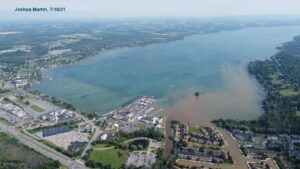 The mid July storm (3+ inches in some areas over 36 hours), generated substantial runoff from the watershed land area into the lake. This can add nutrients to the lake that can increase the potential for algae blooms. There are also internal ecosystem dynamics in the lake that favor cyanobacteria (blue green algae) which may form harmful algal blooms at high concentrations.

 Ontario County Soil and Water Conservation District (SWCD) just wrapped up multiple erosion and sediment control projects in the Canandaigua Lake Watershed. This project utilized funding from the Finger Lakes-Lake Ontario Watershed Protection Alliance (FLLOWPA). The first project included installing a basin to collect water coming from a road culvert. High flows of water are then redirected into a grassed waterway with underground tile to eliminate erosive overland flows which have caused severe cutting in the agricultural field. This system will help manage erosion in the agricultural field, and reduce sediment loss by up to 20 tons of soil/acre/year across the project site. The project was stabilized through hydroseeding by the Ontario County Highway Department. This erosion and sediment control project will prevent soil from entering streams leading to Canandaigua Lake. The farm expressed concerns about the eroding area for several years and worked closely with Ontario County SWCD to develop a management plan that meets both water quality concerns while still allowing the field to be farmed efficiently.


