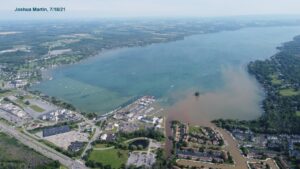
Water Quality Update for August 13, 2021

In this issue:

  • Water Quality Update for 8/13/2021
  • Don’t Forget – LED Flares available at Wegmans! 
  • About HABs: photos, resources, and further reading


So far this week: 

  • 30 surveys performed 
  • No blooms reported 

Welcome to your Friday Water Quality Update! This week’s update will be short and sweet. 

There have been no blooms reported this week by CLWA volunteers or watershed staff.  

We have been seeing an overall increase in the weekly average water clarity as reported by Secchi Disk volunteers. There was a meter increase in the weekly average clarity from last week!

Comparing the secchi disk readings from this time frame last year (2nd week in August), we saw better average clarity by 2.5 meters.  In 2020, the weekly average clarity the second week in August was 4.37 meters, and in 2021, it was 7.02 meters. It will be interesting to closely track changes in clarity in the coming weeks as we transition into the season where we have historically seen bloom events (late August / early September). 

Conditions can change quickly in August, so please continue to use your visual indicators to look for signs of active bloom conditions. As recommended by the DEC, if you see it, avoid it. If you have a question on a suspected bloom, please feel free to send in a photograph to HABs@canandaigualakeassoc.org. This email address is monitored by CLWA and Canandaigua Lake Watershed Council staff. We may be able to assist with identification though a clear photograph. 

Volunteers and watershed staff will be continuing daily observations throughout August and September and we will communicate any significant changes in bloom activity through our weekly email updates, on our website, and on our facebook page

Enjoy your weekend!

Posted in News, Water Quality Updates

Water Quality Update for August 6, 2021

In this issue:

  • Water Quality Update for 8/6/2021
  • Register today! CLWA Annual Meeting on Tuesday, August 10th at 7 PM  
  • About HABs: photos, resources, and further reading


Welcome to your Friday Water Quality Update!

Routine monitoring began this week as part of the Volunteer Shoreline Harmful Algae Bloom Program. For the next 9 weeks, 70 CLWA volunteers will be submitting “bloom” and “no bloom” reports  throughout the week, and in some cases collecting samples for analysis at the Finger Lakes Institute. The data collected, along with professional watershed staff surveys performed by the Canandaigua Lake Watershed Council, will be providing us with a good overall assessment of lake conditions. 

Water Quality Update : Current Conditions 

Three suspicious blooms were reported this week by trained volunteers – two on Thursday (8/5) and one this morning (Friday, 8/6). Volunteers observed areas of suspended algae in the water column and very light surface streaking. In an effort to provide the most up to date information available, a sample was collected this morning from one of the suspicious blooms in Crystal Beach and brought to the Finger Lakes Institute for analysis. Results indicated that the CyanoChlorophyll (measurement of cyanobacteria, or blue green algae) did not exceed the bloom threshold, meaning this was not a bloom. 

While this is good news, conditions may be setting up for heavier concentrations of cyanobacteria when the conditions are just right – mainly on calm, dry, sunny days.  Overall, water quality conditions have been looking pretty good this week, with secchi disk readings bouncing back into the mid 6 meter range, indicating better clarity. 

A general assessment of this summer’s conditions thus far.

The mid July storm (3+ inches in some areas over 36 hours), generated substantial runoff from the watershed land area into the lake. This can add nutrients to the lake that can increase the potential for algae blooms.  There are also internal ecosystem dynamics in the lake that favor cyanobacteria (blue green algae)  which may form harmful algal blooms at high concentrations.  Factors at play include the changes in our lake ecosystem brought on by invasive quagga and zebra mussels, and increasing lake temperatures. 

Conditions can change quickly in August, so please continue to use your visual indicators to look for signs of active bloom conditions. As recommended by the DEC, if you see it, avoid it. If you have a question on a suspected bloom, please feel free to send in a photograph to HABs@canandaigualakeassoc.org. This email address is monitored by CLWA and Canandaigua Lake Watershed Council staff. We may be able to assist with identification though a clear photograph. 

Volunteers and watershed staff will be continuing daily observations throughout August and September and we will communicate any significant changes in bloom activity through our weekly email updates, on our website, and on our facebook page. 

Enjoy your weekend!

Posted in Uncategorized

Water Quality Update for July 30, 2021

In this issue:

  • Water Quality Update for 7/30/21
  • Erosion & Sediment Control Projects in the Canandaigua Lake Watershed
  • Register today! CLWA Annual Meeting on Tuesday, August 10th at 7 PM 


Water Quality Update : Current Conditions 

Welcome to your Friday Water Quality Update. This week, we are happy to share there were no blooms reported  by volunteers or watershed staff.  

We have been observing a steady decrease in the weekly average water clarity throughout the month of July, as reported by Secchi Disk volunteers.  This summer’s rain events, combined with the natural progression of the phytoplankton community in the lake, mean that clarity has decreased as we have seen an increase in suspended / dissolved materials and a natural increase in algal production. Volunteers provide weekly readings from 17 locations around the lake, giving us a good assessment of overall lake clarity. Individual readings submitted this week seem to indicate a slight increase in clarity, getting back up into the 6 meter depth from 4-5 meters in recent weeks. We thank our wonderful volunteers for providing these readings, as clarity is an important assessment tool which may indicate an upcoming bloom event.   


As shared in last week’s update, we may also continue to see watermeal and duckweed at locations around the lake, as rain events flush these tiny aquatic plants from the West River and other tributaries. Watermeal and duckweed can easily be mistaken for a harmful algae bloom (HAB). See last week’s update for further information and photos.  

As we head into August, we welcome the official start date of the Volunteer Shoreline Harmful Algae Bloom Monitoring Program on Monday, August 2nd. Starting next week, HABs volunteers will be providing weekly reports on the algal activity in their designated shoreline zone. This summer, we are thrilled to have the assistance of 71 volunteers! Each volunteer has been trained to identify blooms and report their findings using an online portal developed by our friends at Seneca Lake Pure Waters that will make real-time HABs information available to the public on the CLWA website. This information will also keep you, CLWA members and followers, aware of the water’s conditions via our Friday email updates.  

Please continue to use your visual indicators to look for signs of active bloom conditions. As recommended by the DEC, if you see it, avoid it. If you have a question on a suspected bloom, please feel free to send in a photograph to HABs@canandaigualakeassoc.org. This email address is monitored by CLWA and Canandaigua Lake Watershed Council staff. We may be able to assist with identification though a clear photograph. 

Volunteers and watershed staff will be continuing daily observations throughout August and September and we will communicate any significant changes in bloom activity through our weekly email updates, on our website, and on our facebook page. 

Enjoy your weekend!


Erosion & Sediment Control Projects in the Canandaigua Lake Watershed
By Ontario County Soil and Water Conservation District 

Ontario County Soil and Water Conservation District (SWCD)  just wrapped up multiple erosion and sediment control projects in the Canandaigua Lake Watershed. This project utilized funding from the Finger Lakes-Lake Ontario Watershed Protection Alliance (FLLOWPA). The first project included installing a basin to collect water coming from a road culvert. High flows of water are then redirected into a grassed waterway with underground tile to eliminate erosive overland flows which have caused severe cutting in the agricultural field. This system will help manage erosion in the agricultural field, and reduce sediment loss by up to 20 tons of soil/acre/year across the project site. The project was stabilized through hydroseeding by the Ontario County Highway Department. This erosion and sediment control project will prevent soil from entering streams leading to Canandaigua Lake. The farm expressed concerns about the eroding area for several years and worked closely with Ontario County SWCD to develop a management plan that meets both water quality concerns while still allowing the field to be farmed efficiently. 

On another project, the Ontario County SWCD partnered with the Canandaigua Lake Watershed Council and the Town of Gorham on an erosion control project with cost-share funding provided through the Finger Lakes Ecosystem-Based Management (EBM) program. The project consisted of installing 2 water control structures along with the stabilization of 700’ of streambank on a length of stream that was severely eroding through a farm field. This project resulted in the installation of both water retention as well as hard structures to control water volumes and help prevent erosion. This project will prevent the loss of an estimated 52.5 tons of soil per year on the stretch of treated streambank.


Register today!

The Annual Meeting is a great place to hear about current watershed initiatives! Join us virtually for a business meeting with our year in review, officer and director elections, reports from the Chair and Treasurer, and award recognitions including the announcement of our 2021 Photo Contest winners.

After the business meeting, stay for a presentation with Dr. Lisa Cleckner, Director of the Finger Lakes Institute at Hobart and William Smith Colleges, on Canandaigua Lake research initiatives.


Posted in News, Water Quality Updates

Water Quality Update for July 23, 2021

Water Quality Update for July 23, 2021 

In this issue:

  • Water Quality Update for 7/23/21
  • What are those Flag Markers Close to Shore?  
  • Boating Advisory from the Ontario County Sheriff


Water Quality Update : Current Conditions 

Welcome to your Friday Water Quality Update. This week, we are happy to report there were no blooms observed by volunteers or watershed staff.  

Since last week’s edition, we have experienced some intense rain events across the Finger Lakes. These rain events have flushed an abundance of duckweed and watermeal from the West River and other tributaries, which can easily be mistaken for a harmful algae bloom (HAB). See photos below. 

Duckweed and watermeal (Lemna spp. and Wolfia spp., respectively) are tiny floating aquatic plants that are among the smallest flowering plants on earth. They are native to our local ecosystem, and can proliferate rapidly. Often, the two species will be found together on the water’s surface, and may clump together or form into long “streaks”. These streaks can sometimes be observed in large swaths running down the length of the lake! Prevailing winds may also push duckweed and watermeal into coves or along shorelines and can easily be mistaken for a HAB, especially when observed from a distance.  

Image 1: Watermeal from 7/15 in Cottage City – Not a HAB

Image 2: An image submitted by a lake resident on July 16th – Not a HAB

Image 3: CLWA HABs Team Leader Sally Napolitano laid a piece of paper over the water in an area of observed duckweed. . What adhered to the paper is mostly watermeal, but the larger “dots” are duckweed. Microcystis which usually comprises the HABs we see here on Canandaigua Lake are smaller than this by magnitudes. Not a HAB.


Duckweed and watermeal do not produce toxins and are not harmful to human or pet health. However, during HABs season, you may sometimes see these aquatic plants mixed in with a harmful algae bloom. In that case, they should be avoided. 

If you have a question on a suspected bloom, please feel free to send in a photograph to HABs@canandaigualakeassoc.org. This email address is monitored by CLWA and our Watershed Program Manager, Kevin Olvany, at the Canandaigua Lake Watershed Council. We may be able to assist with identification though a clear photograph. 

Please continue to use your visual indicators to look for signs of active bloom conditions. As recommended by the DEC, if you see it, avoid it.

Volunteers and watershed staff will be continuing daily observations throughout July, August and September and we will communicate any significant changes in bloom activity through our weekly email updates, on our website, and on our facebook page. 

Enjoy your weekend!


What are those flag markers close to shore? 

Boaters or waterfront residents may have noticed orange flags in several areas around the lake recently. These flags are marking buoys for gill nets, placed by the DEC Fisheries. 

The DEC has been performing standard lake trout netting to help fisheries biologists track the lake trout population and monitor growth, stocking success, natural reproduction, among other markers of fish health.

DEC performs these surveys every few years and compares results from previous netting surveys to track the density of lake trout populations. Survey information is used alongside Angler Diary data and forage fish (smelt, alewife, sculpin, etc) data to determine if lake trout stocking rates need to be adjusted. Brown trout and rainbow trout are also an important component of the trout fishery which need to be considered when the DEC evaluates stocking levels. 

To read more about the DEC’s Angler Diary Program, visit: https://www.dec.ny.gov/outdoor/27875.html 


Boating Advisory from the Ontario County Sheriff

The Ontario County Sheriff’s Office released a boating advisory on July 19th, 2021 for Canandaigua and Honeoye Lakes regarding the presence of debris and logs in the lakes due to the amount of rainfall received last weekend. Boaters should proceed with caution in the water and are encouraged to report areas that may pose a hazard. See the full advisory in the image below.


Posted in News, Water Quality Updates

Water Quality Update for July 16, 2021

  • Water Quality Update for 7/16/21
  • PhD Student Launches Artificial Substrate Project on Canandaigua Lake this Summer
  • Calling all Divers: Kershaw Kleanup on 8/2

Water Quality Update

As no news is often good news, we are happy to report that there were no blooms observed by volunteers or watershed staff this week. 

With help from our friends at Seneca Lake Pure Waters, we are pleased to announce that the 2021 interactive HABs map is now live on the CLWA website and can be found on our Shoreline Monitoring page. This map provides real time information from volunteer monitors as soon as they upload a bloom report. Visitors to the page can click on the red dots to pull up information submitted, including the date bloom was reported, location,  bloom extent, description, as well as photos. Please note that this map serves as a record of the blooms that have been reported over the previous 2 weeks. Water quality conditions can change daily, if not hourly. 

As we move into late July, please continue to use your visual indicators to look for signs of active bloom conditions. As recommended by the DEC, if you see it, avoid it.

Volunteers and watershed staff will be continuing daily observations throughout July, August and September and we will communicate any significant changes in bloom activity through our weekly email updates, on our website, and on our facebook page. To report suspicious blooms, use HABS@canandaigualakeassoc.org.

Enjoy your weekend!


PhD Student Launches Artificial Substrate Project on Canandaigua Lake this Summer
With Information provided by Abby Webster, PhD student at SUNY College of Environmental Science and Forestry 

Abby Webster is a first-year PhD student at SUNY ESF studying harmful algal blooms in the Finger Lakes. This summer, she has joined the team at the Finger Lakes Institute in Geneva, where she is designing an artificial substrate to deploy in lakes with hopes of capturing benthic (or attached) cyanobacteria. While we are most familiar with planktonic or surface water harmful algal blooms in the Finger Lakes, we know benthic algae also grows here. There are many unknowns to benthic cyanobacteria, such as when they grow and what toxins they produce that may be harmful to us like their planktonic counterparts. The artificial substrate she is deploying will serve as a monitoring tool throughout the summer to quantify and characterize the benthic cyanobacterial growth and look to answer these questions.

The artificial substrate is composed mainly of small ceramic tiles (6 x 6″), 24″ PVC, and paracord. The design stands vertically in the water column – attached to an anchor on the bottom and a buoy at the surface. See attached image of design drawing for reference.

Abby has deployed three of these artificial substrate racks on the east side of Canandaigua Lake near Cottage City, with permission from friendly lake residents and CLWA Members  Andrea Odenbach, Tom Vecchi, and Sally Napolitano. Sally serves as a CLWA Board Member and Citizen Science Committee Chairperson, and has helped coordinate with FLI on several research projects over the last few summers. CLWA is grateful for our member’s assistance to help move this important science forward! 

In addition to using the artificial substrate to better understand benthic growth throughout the summer season, the team plans to submit both biofilm and water samples for genetic characterization to Cornell University. To pair with genetic data, toxin analysis will also be performed through Dr. Greg Boyer’s lab at SUNY ESF, testing for several cyanotoxins including microcystin and anatoxins. Another aspect of this work will be performing pigment extraction on the attached biofilms and surrounding water to compare with our sonde data that will be deployed at Sally’s dock. The sonde measures the pigment phycocyanin, which gives cyanobacteria its blue-green appearance. Laboratory methods will be used to extract the phycocyanin (in-vitro) and analyze its concentration using a fluorometer, to which they will compare the concentration measured by the in-situ sonde. There is also a pigment phycoerythrin, which is produced under low-light conditions, so we wonder if it may be a more appropriate measure for benthic cyanobacteria monitoring.The team is investigating if they can detect differences in phycocyanin and phycoerythrin concentrations between water and attached biofilm, as well as near-surface and near-bottom artificial substrate.


Calling All Divers: Kershaw Kleanup on August 1, 2021

Posted in News, Water Quality Updates

Water Quality Update for Friday, July 9 2021

  • Water Quality Update for July 7 2021
  • Be Flare Aware: Converting to LED Flares for our Ring of Fire Celebrations   
  • About HABs: photos, resources, and further reading


Water Quality Update for 7/9/2021

Cooler temperatures and a few rain events this week have kept water conditions quite nice. There have been no blooms observed by volunteers or watershed staff in our routine surveys this week. 

We received results from last week’s isolated blooms. As you may recall from last Friday’s update, volunteers observed blooms on Tuesday 6/29, and Thursday  7/1. Two samples were collected from the bloom on 7/1; one representing a typical bloom condition, and one from a “worst case” scenario, showing the heaviest concentrations of cyanobacteria. 

Samples were brought to our research partners at the Finger Lakes Institute in Geneva, and analysis was performed in their lab using a fluoroprobe- an instrument that measures chlorophyll with algal class determination. Profiles for Green Chlorophyll, Cyano Chlorophyll,  Diatom Chlorophyll, Cryptophyte Chlorophyll, and Total Chlorophyll are part of this analysis, and the occurrence of and measurements for each are used to deem an active bloom. In New York State, a bloom is defined as having a cyano chlorophyll concentration of greater than 25 μg/L (micrograms per liter). 

Results from the three blooms reported last week are shared below.  


As you can see, the two samples collected were above the bloom threshold. Within the day, blooms had dissipated, which reiterates the fact that water conditions can change very frequently. 

Secchi Disk reports from this week show the average weekly clarity has held in the 6.6 – 6.8 meter range for the last two weeks. After a nearly 10-degree average surface water temperature spike at the end of May / early June, our current average water temperature has been holding in the 60-70 degree range for the last several weeks. 

Volunteers and watershed staff will be continuing our monitoring throughout the summer and will share notifications of condition changes. 

Enjoy the weekend! 

Be Flare Aware: Converting to LED Flares for our Ring of Fire Celebrations   

You may have seen the new LED Flares available at Wegmans these last few weeks . CLWA hopes that if you normally purchase road flares for the Ring-of-Fire celebration over Labor Day weekend, that you instead consider buying LED Flares. They are a much safer alternative (for humans and the watershed) without compromising the fun!  

Please read more about LED Flares and how Wegmans in Canandaigua is donating $1/flare sold to CLWA!


LED Flares: A Lake Friendly Alternative for Ring of Fire

Every summer, incendiary highway flares create the beautiful red glow we know and love during the Ring of Fire. While creating an exciting fizz and bright light, they also leave behind potassium perchlorate burn-off, which contaminates the air, soil, and lake, in addition to leaving behind metal spikes that can pollute the lake.

Consider a new lake-friendly tradition this summer: LED flares. 

CLWA, with the wonderful assistance of CLWA members Greg Talomie and Charlie Constantino, has found an environmentally sensitive alternative without compromising tradition: we invite all Canandaigua lake-side residents to join with the numerous area lakes that have taken a pledge this year to convert to LED flares, cutting down on the use of approximately 77,000 incendiary flares. 

In 2017, CLWA stopped selling incendiary flares as a fundraiser to align with our mission to protect the lake’s water quality and shores from environmental hazards. Today, CLWA’s efforts have gone a step further with a special collaboration courtesy of Wegmans grocery stores. 

Purchase your LED flares from Wegmans in Canandaigua.

Wegmans in Canandaigua, and in eight other Finger Lakes locations, will no longer sell incendiary flares. The grocery store now will carry a Wegmans branded LED flare that is re-useable, shines long into the night, has a flicker mode, and can be seen one mile across the lake–all without leaving a chemical residue. These units resemble traditional flares and average approximately 90 to 100 hours of run time on regular or re-chargeable +AAA batteries. Although more expensive than the chemical flares, LED flares can save money over time because they are re-useable from year to year and can be used in a vehicle or boat.

Wegmans also is donating to the Canandaigua Lake Watershed Association $2.00 for every two-pack sold and $6.00 for every six-pack sold at its Canandaigua store through the end of September.

One more thing: Please recycle your batteries. Recycling batteries keeps dangerous materials out of landfills. Batteries contain heavy metals such as mercury, lead, cadmium, and nickel. If released, these metals may be harmful to humans and the environment. Check with your town or trash hauler to find out if they can separate batteries that you divert from your trash. Or, consider using re-chargable batteries.

CLWA encourages the conversion from using incendiary flares to LEDs!


Posted in News, Water Quality Updates

Water Quality Update for Friday July 2, 2021

As we kick off summer with the long holiday weekend, we welcome back our water quality monitoring programs and the return of our weekly “Water Quality Updates”.

Each Friday throughout the summer months, CLWA along with our partners at the Canandaigua Lake Watershed Council will send a weekly report summarizing current Canandaigua Lake conditions, using information collected by our dedicated group of CLWA volunteers, watershed staff observations, and beach closure data made available from the Department of Environmental Health in Geneva

To take a closer look at the programs that inform these reports, please check out the program descriptions below. And as always, you can visit the CLWA website for the most up to date information available. 

Shoreline HAB(s) Monitoring Program
This summer marks the 4th year of the Volunteer Shoreline Harmful Algae Bloom(s) (HABs) Monitoring Program.  In 2018, CLWA started with 16 volunteers monitoring zones around the lake for signs of HABs. We are pleased to report that in 2021, the program has grown to 69 volunteers! Each volunteer has been trained to identify blooms and report their findings using an online portal developed by our friends at Seneca Lake Pure Waters that makes real-time HABs information available to the public. Look for the 2021 HABs map coming soon on the Shoreline HABs Monitoring page on the CLWA website. 

The Canandaigua Lake HABs Monitoring Program (CLWA Volunteer HABs Shoreline Monitoring program) is a collaborative effort led by a local consortium of organizations: the Canandaigua Lake Watershed Association (CLWA), the Canandaigua Lake Watershed Council (CLWC), and the Finger Lakes Institute at Hobart and William Smith Colleges (FLI), working in collaboration with the New York State Department of Environmental Conservation (NYSDEC). Through daily (weekly) water quality monitoring, testing, and reporting, we are gaining knowledge of the HABs dynamics in Canandaigua Lake. In an effort to increase understanding on the impacts of HABs on water quality, the information collected is shared with partners, researchers, water purveyors, environmental health departments, and the greater watershed community.    

Secchi Disk Water Clarity Monitoring Program
Our incredibly dedicated group of secchi disk volunteers have been out since May monitoring water clarity, water temperature, and participating in lake user perception surveys. This important program tracks changes in clarity, turbidity, and algal abundance throughout the water column, notifying us of changes throughout the summer months. In 2021, volunteers are monitoring 18 sites around the lake.  Data collected is reported in real time, and can be found by visiting the Secchi Disk page on the CLWA website. 

WATER QUALITY WEEKLY REPORT
While this year’s HABs program was scheduled to “officially” begin in early August, the intense temperatures we have been experiencing over the last few weeks gave us a hunch that we should start earlier. With our training sessions held in June, volunteers were ready to rise to the occasion!   

On June 29th, we had our first official visual bloom report of the season from one of our returning volunteers. An area of visible surface streaking was observed approximately 3 miles down on the east side of the lake, in 2-3 feet of water about 10-15 feet off shore. By the time a HABs team leader was able to visit the site to get a sample, the bloom had dissipated. 

On July 1st, we received a report around 10:00 am of a potential bloom area by a trained sampling volunteer on the west side of the lake, and 2 samples were collected from 2 different shoreline areas expressing different levels of cyanobacteria. These samples were transported to the Finger Lakes Institute in Geneva for analysis on a fluoroprobe, an instrument used by FLI laboratory staff to measure levels of blue green chlorophyll and species of cyanobacteria. Official results are forthcoming but samples are above the DEC bloom threshold of 25 ug/L. 

These recent observations, combined with a slight decrease in the weekly average water clarity reported by our secchi disk volunteers, is telling us that we may begin to experience isolated areas of blooms in the coming weeks, especially on hot, calm, dry days. Please understand, we are nowhere near lake-wide bloom conditions, as these early reports have been isolated in nature. Watershed staff did site visits at multiple locations and no other blooms were observed at that time.  As we know, conditions can change rapidly,  and there is potential for increased cyanobacteria concentrations when the conditions are right. Please use your visual indicators to look for signs of active blooms.  As recommended by the DEC, if you see it, avoid it.

Volunteers and watershed staff will be continuing daily observations throughout July, August and September and we will communicate any significant changes in bloom activity through our weekly email updates, on our website, and on our facebook page. Stay tuned! 

Update on the Recent Fish Die off
CLWA and the Canandaigua Lake Watershed Council fielded several calls in early to mid June regarding increased numbers of dead fish found along shorelines. While we typically might see some die off in late spring brought on by factors such as post-spawning stress, rapidly increasing water temperatures, and ecological changes in the food web, this spring’s die off was more sustained. DEC Region 8 Fisheries staff was contacted to investigate and samples were collected and brought to Cornell Veterinary School for analysis. 

DEC Region 8 Fisheries provided the following update: 

DEC Fish Die off Update

DEC investigated recent reports of a fish die-off affecting rock bass, sunfish, smallmouth bass, and white sucker in Canandaigua Lake. Samples were obtained from impacted white sucker and smallmouth bass for analysis at the Cornell Veterinary School.

Results came back showing an infection of the bacteria Aeromonas.  Aeromonas is commonly found in water and by themselves, are not a concern.  DEC suspects that the warmwater fish in Canandaigua Lake became stressed from spawning, temperature swings, or some other stressor. This resulted in their immunity being lowered and allowed the bacteria to infect the fish.  Aeromonas does not pose a threat to humans or pets utilizing Canandaigua Lake.

As always, people should not drink unfiltered lake water and obviously sick fish should be avoided. If stressed or dead fish are handled, people should wear gloves or wash their hands with soap and water after. With proper preparation, healthy fish are safe to eat. People should continue to report large numbers of dead fish to DEC at 585-226-5343 or fwfish8@dec.ny.gov

Posted in News, Water Quality Updates

Update from the DEC on Fish Die off on Canandaigua Lake

DEC Fish Die off Update

DEC investigated recent reports of a fish die-off affecting rock bass, sunfish, smallmouth bass, and white sucker in Canandaigua Lake. Samples were obtained from impacted white sucker and smallmouth bass for analysis at the Cornell Veterinary School.

Results came back showing an infection of the bacteria Aeromonas.  Aeromonas is commonly found in water and by themselves, are not a concern.  DEC suspects that the warmwater fish in Canandaigua Lake became stressed from spawning, temperature swings, or some other stressor. This resulted in their immunity being lowered and allowed the bacteria to infect the fish.  Aeromonas does not pose a threat to humans or pets utilizing Canandaigua Lake.

As always, people should not drink unfiltered lake water and obviously sick fish should be avoided. If stressed or dead fish are handled, people should wear gloves or wash the hands with soap and water after. With proper preparation, healthy fish are safe to eat. People should continue to report large numbers of dead fish to DEC at 585-226-5343 or fwfish8@dec.ny.gov

Webster Pearsall
Region 8 Fisheries Manager
6274 East Avon-Lima Road
Avon, NY 14414
web.pearsall@dec.ny.gov
585-226-5339
607-422-7136 (cell)

Posted in News

CLWA Rallies Volunteers in Fight Against Gypsy Moth Defoliation

Canandaigua Lake Watershed Association Rallies Volunteers in Fight Against Gypsy Moth Defoliation

More than 120 concerned citizens support CLWA events at Bare Hill, Gannett Hill and Stid Hill to destroy millions of caterpillar eggs.

May 13, 2021 — Canandaigua, NY — More than 120 CLWA volunteers attended three Canandaigua Lake Watershed Association (CLWA) Gypsy Moth Scout and Scrape-a-thons at Bare Hill in Rushville, Gannett Hill in Naples, and Stid Hill in Canandaigua, helping reduce the number of gypsy moth caterpillars hatching this spring by an estimated 22,014,000.

The Gypsy Moth Scout and Scrape-a-thons were held at Bare Hill Unique Area on April 17, Ontario County Park at Gannett Hill on April 23, and at Stid Hill Wildlife Management Area on May 1. CLWA board members and volunteers participated in the three, two-hour workshops and, after a brief orientation, scraped an estimated 27,500 egg masses. According to the New York State Dept. of Environmental Conservation (NYS DEC), a gypsy moth egg mass can contain 300 to 1,000 eggs. CLWA calculated the events in total prevented approximately 22,014,000 gypsy moth caterpillars from reaching adulthood and negatively affecting already stressed hardwood trees in the parks.

“As the pandemic approached its one-year anniversary of restrictions, school closings, and cancelling of events, we wanted to hold a socially-safe, environmentally sensitive, in-person, outdoor event aimed at mitigating the invasive and ‘naturalized’ gypsy moth,” said CLWA Board Member and Event Organizer Lynn Klotz. “I am truly impressed by the number of volunteers who came to our events, many even traveling from outside of the watershed area.”

The Gauvin-Smith family from Pittsford came out as a team to Stid Hill in Naples for the Canandaigua Lake Watershed Association Gypsy Moth Scout & Scrape-a-thon on May 1, 2021, to help reduce the caterpillar population this spring. Pictured (L-R) are Eliza Gauvin, Kellie Gauvin, Jocelyn Gauvin and Byron Smith.

Awareness and success of the Scout and Scrape-a-thons were due in large part to support from multiple CLWA partners, including the NYS DEC, Ontario County Dept. of Public Works, Finger Lakes PRISM, Ontario County Soil and Water Conservation District, Fingers Lakes Museum, and local author and retired Finger Lakes Community College professor Martin Dodge.

Garrett Koplun, Forester, Division of Lands and Forests, NYS DEC, said, “Many thanks to CLWA for the extra effort the organization has put into mitigating the negative impact of the gypsy moth this spring. Keeping our trees and forests healthy and vigorous is becoming an increasing challenge. Success depends upon public stewards being informed, getting involved, and reporting problems.”

Each Scrape-a-thon volunteer received a native sapling for participating, and CLWA is grateful to Wayne County Soil & Water Conservation District for donating extra saplings to the cause.

“This is incredible! Very impressive numbers, both in eggs scraped and volunteers participating. Thank you again for coordinating this effort.  I think this was a great success for educating the public about forest health concerns and how they relate to the lake. Now hopefully your efforts, and maybe help from nature, can provide some relief this summer and cripple the regional moth population. Time will tell,” said Michael Palermo, Biologist, Division of Fish and Wildlife, NYS DEC.

About Gypsy Moths
Gypsy moths were introduced to the US in 1869, when the species was brought from France to Medford, Massachusetts, in the hope they could breed with silkworms to create a hardier variety of silkworm and develop a silk industry in the US. More than 150 years later, gypsy moths can now be found in 22 states and have been well-established in New York for more than a century. Unfortunately, despite major state and national efforts to stop or slow the spread of gypsy moth, it is naturalized in New York.

Gypsy moths have devastated millions of forested acres in the Northeast, defoliating both deciduous and conifer trees, both of which are vital in protecting lakes by controlling erosion, reducing contaminants from entering waterways, and providing habitat for native pollinators, plants, and animals. They feed on more than 300 species of trees and shrubs although they prefer oaks, causing extensive tree mortality. Deciduous trees can withstand up to three years of defoliation, but conifers often die after the first year, especially if already stressed.

A video of the gypsy moth egg masses on a tree at Ontario County Park can be found here: https://youtu.be/3_LoH_QVTT4

What Property Owners Can Do
Removing and destroying the egg masses is essential as they can survive if dropped to the ground, and hatch beginning in April through May. Removing egg masses is best done prior to the hatching, and destroying the eggs by soaking them in soapy water for 48 hours is recommended.

The DEC Division of Lands and Forests responded to the regional gypsy moth outbreak in 2020 by offering two webinars on the subject for outreach and education to landowners, consultant foresters, municipalities, arborists, and other impacted groups. More information can be found on the NYS DEC website here.

About CLWA
The Canandaigua Lake Watershed Association (CLWA) is a non-profit, membership-based organization working to preserve, protect, and restore Canandaigua Lake and its watershed for future generations to enjoy and explore. Our mission is to inspire the entire watershed community to become stewards of Canandaigua Lake through education, scientific research, and advocating sound public policy.  For more information about CLWA, visit www.canandaigualakeassoc.org, follow us on Facebook and Instagram.

#  #  #

Press Contact: Sue Martenson, CLWA
978 905 9582
suemartenson@gmail.com


At Bare Hill in Rushville on April 17, 2021, Debbie Lyon, Director of the Finger Lakes Museum, scrapes egg masses for the Canandaigua Lake Watershed Association Gypsy Moth Scout & Scrape-a-thon to help remove egg masses from trees in the park.


Canandaigua Lake Watershed Association Board Member Lynn Klotz welcomes volunteers to Bare Hill in Rushville on April 17, 2021, as they prepare to scout for and scrape egg masses during this spring’s CLWA Gypsy Moth Scout & Scrape-a-thon to mitigate caterpillar populations at area parks.


Canandaigua Lake Watershed Association (CLWA) Gypsy Moth Scout & Scrape-a-thon organizers at Gannett Hill event on April 23, 2021: (from L-R) CLWA Director Lindsay McMillan, CLWA Board Members Sonya Carnevale and Lynn Klotz, and CLWA volunteer Susan Martenson.


Bundling up to stay warm, Good Shepard Lutheran Church Pastor Don Muller and wife Roxann of Canandaigua, brave the snow and icy winds to scrape egg masses at Gannett Hill on April 23, 2021, for the Canandaigua Lake Watershed Association Gypsy Moth Scout & Scrape-a-thon to help mitigate the caterpillar population.


Volunteers gather at Stid Hill on May 1, 2021, to listen in as Canandaigua Lake Watershed Association Board Member Sonya Carnevale explains how to scrape gypsy moth egg masses to help reduce the caterpillar population.

Posted in News